Somebody help me out here

I got this email yesterday:

Hi John,

I’ve decided to run for lieutenant governor of Vermont in 2010. I’ve included the text from my announcement below, which is followed by links to my campaign platforms, my campaign promises, and the Bungalow Benchly for Lieutenant Governor of Vermont Facebook page. The announcement is fun, but if you’re looking for substance, I recommend the platforms and promises. Remember, Yes Benchly Can!

I would like to take this opportunity to announce my candidacy for lieutenant governor of the fine state of Vermont. (I am not kidding.)

A very entertaining email followed (I’ll put the whole thing below the fold.

So, Bungalow is a long time Vermont blogger (not a political blogger, but a blogger-blogger). His original livejouranal site (“The Continuing Story of Bungalow Benchly”) can be found here. His current site “Benchly’s Sword” can be found here. His announcement is here.

His bio from the livejournal site simply says “I’m quirky. Period.” In his announcement, along with a list of leftist staple positions, he promises “jukeboxes in all school cafeterias!”

So… er… there ya go. After you read the letter, you’ll kinda want to vote for him. Sort of takes me back to my own announcement of a run for office.

Full email:

Hi John,

I’ve decided to run for lieutenant governor of Vermont in 2010. I’ve included the text from my announcement below, which is followed by links to my campaign platforms, my campaign promises, and the Bungalow Benchly for Lieutenant Governor of Vermont Facebook page. The announcement is fun, but if you’re looking for substance, I recommend the platforms and promises. Remember, Yes Benchly Can!

I would like to take this opportunity to announce my candidacy for lieutenant governor of the fine state of Vermont. (I am not kidding.)

After several years of Dubie at the helm (read: waste of money), I think it’s time that the Vermont people declared in a bold and unified voice (with a few calculated pauses for dramatic effect and breaths): “if we’re actually going to spend money on this position, we should at least vote for someone with an even better name than Dubie, even if it is just a nickname.”

The office of the lieutenant governor of Vermont is a very important job. The lieutenant governor is the president of the state senate. Of course, if there’s no lieutenant governor, the constitution simply states that the senate can just pick someone else to be president, but still, Very Big Responsibility! And if the governor should fall ill, the lieutenant governor will be right at his/her side to provide OJ, medicine, and a cold washcloth for the forehead. And should that not work and the governor dies, the lieutenant governor becomes the governor. Whoa!

And I’m sure the lieutenant governor does tons of other fun stuff too, but just because I can’t think of anything other than this primary responsibility of waiting, doesn’t mean they don’t exist.

And it’s because of that responsibility of waiting, which, incidentally, I think I’m pretty good at (e.g., I once waited outside of Best Buy for four hours for a laptop!), and the weight of that responsibility one feels knowing that the governor’s next cough could mean so much, that I have decided that it is absolutely imperative for the fine people of this fine state to pick someone with a lot of time on their hands to wait. And considering that I’m spending so much time on this announcement and my Facebook group, I think we can all agree that I’m the right person for the job.

I love this state. I’m not particularly fond of its slogan “I LoVermont” because, let’s face it, “LoVermont” is not a real word and I’m all about real words, and good grammar, and proper capitalization, but I love this state!

And speaking of proper capitalization, I think it’s worth mentioning that “lieutenant governor” need not be capitalized unless it precedes the person’s name who holds such a position. This bugs me. Same goes for the state senate and president and what not. They’re not proper nouns! OK, I’m done venting.

I love Vermont! And I want to serve Vermont! So please vote for me, Bungalow Benchly for lieutenant governor. I want to be your Lieutenant Governor Bungalow Benchly! (See how I capitalized there?) For those who believe in God, God bless you and God bless Vermont, and for those of you who don’t, have a nice day! And if you’re agnostic, well, that’s OK, too.

– Bungalow Benchly

Bungalow Benchly for Lieutenant Governor Facebook page: http://www.facebook.com/group….

Campaign promises: http://bungalowbenchly.blogspo…

Platforms: http://bungalowbenchly.blogspo…

Leahy getting challenged: did we miss this?

I didn’t get this from any local news source, but I did get it from Talking Points Memo:

Sen. Patrick Leahy (D-VT) is on no one’s list of vulnerable Senators in 2010. But an active duty Navy M.D. says he’s ready to mount a serious challenge to the six term liberal. From the left. Daniel Freilich says he plans to formally announce his bid for Leahy’s seat tomorrow in Wilmington, VT.

Who knew?

End Conflicts of Interests

I spent the weekend with a bunch of other environmental activists up in Maine.  We came from a lot of different places with a number of different concerns, but one consistent theme was conflict of interest in the permit and regulatory processes.

We’re regarded as “lucky” here in Vermont, in that we have at least the semblance of citizen interface within the regulatory process.  However, as we all know, political appointees, cronyism and an absence of consequences for exercising conflicts of interest weaken even our relatively progressive system.

It’s time we demand of our legislators that they apply themselves to the task of crafting specific criteria for assessing conflicts of interest.  Those criteria must not just reflect the traditional relationships of family and employer; but must be designed to include the less traditional relationships  such as life-partnerships.  No one who holds a decision making role on behalf of the public good should be allowed to waiver from those strict criteria.  A specific responsibility to punish violations of Conflict of Interest must be assigned to the Secretary of State, and significant punitive measures must be put into place.   If  a conflict of interest comes into play,and the public decision-maker in question does not recuse him or herself from the process that violation can be easily established and a truly consequential punishment administered, that will serve to deter others from similar behaviors.  

I doubt that many Vermonters are even aware of the fact that, when Gov. Douglas took office, he revised the ethics policy of his administration. It now appears to reflect a certain tolerance for  conflicts of interest.   Here is a link to the entire revised policy.

Note especially this passage and the qualification “irreconcilable” added to “conflicts.”


WHEREAS, it is also essential to the proper operation of government that those best qualified not be discouraged from serving as public officers by requiring them to relinquish totally the opportunity to further their own interests, at least where such interests do not create irreconcilable conflicts with their official responsibilities; and

Even when the policy has been violated, the Governor’s ethics policy offers little in the way of enforcement.  Here follows the entire section devoted to enforcement:

V. Enforcement

The purpose of this Executive Code of Ethics is to provide guidance to gubernatorial Appointees covered herein, and during such appointment, except as otherwise required by law, only the Governor or his designated agent shall have the power to sanction any violations hereof. Nothing in this code shall create a right to continue state employment. The remedy for a violation of post-employment restrictions set forth in Section III(B) shall rest with the Public Body before which the former Appointee appears and, barring unusual circumstances, shall result only in disqualifying the former Appointee from appearing or participating in the particular matter.

The public good is only well-served in the permit and regulatory process if those assuming the mantle of decision-making are held to the highest possible standards of conduct and impartiality.  It’s time for our legislators to demonstrate their commitment to that ideal by establishing strict definitions , responsibility for enforcement, and meaningful consequences with regard to conflicts of interest in the permit and regulatory system.

FAHC Gets Face-Time with H1N1 virus

As of today, FAHC is currently treating at least one confirmed case of H1N1 flu. For anyone who just returned from Mars, the U.S. is suffering from an N1H1 pandemic or as FAHC refers to deadly pandemics: “the expected outbreak of flu this fall.”

With months to prepare, you would think that FAHC would be ready for its H1N1 patients.  You’d be wrong. Let’s just say they are off to a really bad start.  

One of the most basic precautions – as basic to H1N1 as, say, fill up the tank and put the key in the ignition is to driving a car – is to stalk up on masks.  Heck, even the hospital’s website says people entering rooms of H1N1 patients need to wear masks, gowns and gloves.  The mask required for an infectious disease such as H1N1 is the N95 mask.

All healthcare personnel who enter the rooms of patients in isolation with confirmed, suspected, or probable novel H1N1 influenza should wear a fit-tested disposable N95 respirator or better. Respiratory protection should be donned when entering a patient’s room.

True to this basic requirement, FAHC does require that health care workers and those dealing with the H1N1 virus must don an N95 mask. Problem is,FAHC is not so concerned about whether its health care workers are wearing a sterile N95 face mask before entering or after leaving isolation areas with H1N1 flu patients are kept.

Is FAHC experiencing a Katrina moment? We all remember when George Bush complained that no one could ever predict that a big hurricane might strike and the levies in New Orleans might breach. With months of predictions about the scope of the N1H1 pandemic, is FAHC prepared? Melinda “Mindy” Estes, CEO and her prescient infectious disease administrators seem to be blissfully unaware of what is hitting FAHC right now. And the problem is not a lack of resources, lack of beds (yet) lack of technical skill.  This is sheer incompetence by FAHC administrators who are cutting corners by ignoring the well documented safety needs of the community.

Does someone need to tell the CEO and her crackerjack staff what happens when the airborne H1N1 virus starts floating around the family members, patients, staff, patients, health care providers and anyone else unlucky enough to be standing around when the Doctor McSwine says “hey, hold this mask for me until I get back from lunch, I’ll need it again for this afternoon’s rounds.”

There’s more . . .

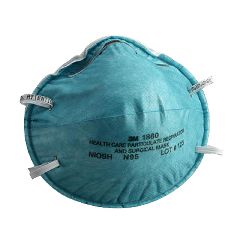
FAHC has a few of these N95 masks.  

Health care workers who are treating N1H1 patients are being fitted with “a” mask and that is the problem. FAHC isn’t prepared, as of October 5, 2009, to supply its workers with sufficient N95 masks.  

FAHC administrators were apparently on the ball enough to realize they needed to order the masks, which physicians, nurses and other health care officials warned them were critical. Unfortunately, no one responsible for patient, staff and community safety bothered to read the directions and make provisions so that enough masks would be available to the health care workers treating H1N1.

Because of this shortage, health care workers are being told by the FAHC administration that they can’t throw their disposable masks away because “there may not be another one to replace it” and they need to “reuse” the contaminated masks that they have already worn.

You read that correctly. Health care workers who are treating H1N1 flu in an isolation area of the hospital are specifically being told by the FAHC administration to “reuse” disposable masks. Feel safer?

So to recap, the U.S. is in the midst of the most widely publicized pandemic in U.S. history.  Luckily for Vermont, our State is late in the game receiving confirmed cases of the deadly N1H1 disease, and luckily for Vermonters, its hospitals had MONTHS to prepare. So why does FAHC not even have basic masks needed to treat N1H1 patients and to protect the public and its medical care staff? Anyone?  Anyone?  Mindy? Bueller? Anyone?  .  .  . .

Is this type of “Flu, what flu?” awareness by Mindy Estes’ crackerjack flu team any indication of what is in store for N1H1 patients at FAHC as Vermont moves from the outskirts of the pandemic into the mainstream?   Let’s hope not.

Fletcher Allen breaking pandemic prevention protocols (UPDATEx4: FAHC strongly disputes accuracy)

UPDATE 4: This from the Freeps today:

Burlington’s Fletcher Allen Health Care confirmed one case Tuesday

Confirming that part of the disclosure doesn’t hurt the whistle-blower’s credibility. I think there may end up being more on all of this.


UPDATE 3: It took some work, but I did finally receive a definitive answer from FAHC’s communications person to the specific question “Did facilities people at FAHC tell medical personnel they had to reuse N95 masks?”

His answer via email was “no.” Specifically (and a bit ambiguously), the answer was “the short answer is no.”

Perhaps ironically followed by the phrase “which i thought i made very clear.”


UPDATE 2: Carrese has forwarded me a few things. Here is an image provided of the masks in question (N95). Here is an image of the masks that can be sterilized and re-used. And here is a word document describing FAHC’s official procedures on the use of the masks in this situation (and yes, sharp-eyed viewers may notice that this document is tagged as being created just this afternoon, but I am confident, either from cutting-and-pasting or whatever, that it is from September).

Of course, none of this contradicts what the whistle-blower reported. The story was not that standard written procedures deviated from appropriate protocols (such as those linked to in the original diary below), or that there were issues with training – the complaint (and the whole point of the diary) was that FAHC facilities administrators had directed them to deviate from standard procedure in a way that was unsafe, and that riled up the actual health care workers who know better. Someone from the facilities department was to be made available to speak with me, but that never actually materialized, unfortunately.

So questions still hang out there. Perhaps some folks on the ground at FAHC will materialize to set the record straight one way or the other. In any event, with this dustup, its probably safe to say that – if the report is accurate – any problem has probably been nipped in the bud.


UPDATE: Michael Carrese, Communications Strategist at Fletcher Allen Health Care strongly disputes this (obviously) whistle-blower driven post, making two points – a) the directive was to reuse and sterilize plastic masks, not the cloth N95 ones, because b) of a national shortage, rather than a specifically Fletcher Allen one. He would not affirmatively say for certain that no such directive was given on the N95 ones. He also took issue with the dual characterizations of sloppiness and the associated concern expressed in this diary – characterizations which, of course, would not be fair if the disclosure turns out to be inaccurate.

I am told that there will be affirmative documentation on the “real” story forthcoming. If the reports about N95 masks are not true, there is still a problem, albeit a rather less dramatic one – specifically communications; that health care workers are not receiving and/or understanding these directives (hence the blown whistle), which could clearly create problems as well.

The quote from the source was that workers were specifically told in regards to the N95 masks “you get one a day.” That makes for a pretty serious misunderstanding, if indeed it turns out to be one.


(Original diary text begins here) As of today, FAHC is currently treating at least one confirmed case of H1N1 flu in critical isolation. For anyone who just returned from Mars, the U.S. is suffering from an H1N1 pandemic or as FAHC refers to deadly pandemics: “the expected outbreak of flu this fall.”

With months to prepare, you would think that FAHC would be ready for its H1N1 patients. Let’s just say they are off to a really bad start.


One of the most basic precautions – as basic to H1N1 as, say, fill up the tank and put the key in the ignition is to driving a car – is to stock up on masks. Even the hospital’s website says people entering rooms of H1N1 patients need to wear masks, gowns and gloves.  The mask required for an infectious disease such as H1N1 is the N95 mask.

All healthcare personnel who enter the rooms of patients in isolation with confirmed, suspected, or probable novel H1N1 influenza should wear a fit-tested disposable N95 respirator or better. Respiratory protection should be donned when entering a patient’s room.

True to this basic requirement, FAHC does require that health care workers and those dealing with the H1N1 virus must don an N95 mask. Problem is, FAHC is not so concerned about whether its health care workers are wearing a fresh and uncontaminated N95 face mask before entering or after leaving isolation areas with H1N1 flu patients are kept.

FAHC isn’t prepared, as of October 5, 2009, to supply its workers with sufficient N95 masks. Health care workers who are treating H1N1 flu in an isolation area of the hospital are specifically being told by the FAHC administration to “reuse” disposable masks, in direct contradiction of public safety protocols.

Is FAHC experiencing a Katrina moment? With months of predictions about the scope of the H1N1 pandemic, is FAHC prepared? Melinda Estes, CEO and her prescient infectious disease administrators seem to be blissfully unaware of what is hitting FAHC right now.

Let’s be clear; the problem is not a lack of resources, or of technical skill. Is this a case of the left hand not knowing what the right hand is up to? Does someone really need to tell the CEO and her crackerjack staff what happens when the airborne H1N1 virus starts floating around the family members, patients, staff, patients, health care providers and anyone else unlucky enough to be standing around when the Doctor McSwine says “hey, hold this mask for me until I get back from lunch, I’ll need it again for this afternoon’s rounds.”?

FAHC does have a few of these N95 masks.  

FAHC administrators were apparently on the ball enough to realize they needed to order the masks, which physicians, nurses and other health care officials warned them were critical. Unfortunately, no one responsible for patient, staff and community safety bothered to read the directions and make provisions so that enough masks would be available to the health care workers treating H1N1.

Because of this shortage, health care workers are being told by the FAHC administration that they can’t throw their disposable masks away because “there may not be another one to replace it” and they need to “reuse” the contaminated masks that they have already worn (and, as you might expect, the workers on the pandemic front lines are not happy about this directive from the FAHC facilities department).

You read that correctly.

So to recap, the U.S. is in the midst of the most widely publicized pandemic in U.S. history.  Luckily for Vermont, our State is late in the game receiving confirmed cases of the deadly H1N1 disease, and luckily for Vermonters, its hospitals had MONTHS to prepare. So why does FAHC not even have basic masks needed to treat H1N1 patients and to protect the public and its medical care staff? Anyone? Anyone? Mindy? Bueller? Anyone…?

Is this type of “Flu, what flu?” awareness an indication of what is in store for H1N1 patients at FAHC as Vermont moves from the outskirts of the pandemic into the mainstream? Let’s hope not.

State House 2010: The Vermont District Index

( – promoted by Jack McCullough)

As we round the corner towards 2010, the political rumor season is heating up. We've already seen the slew of names being batted around for Governor, Lt. Governor, and other statewide offices. 2010 is setting up as a year of tremendous political turnover in Vermont, and so now the question becomes this: how will we capitalize on what should be an election full of open seats and contested races.

For the past few weeks, I've been running through numbers from the Secretary of State's office, trying to compose a ranking profile that could lend hints towards potential Democratic gains, vulnerable incumbents, and district mismatches. Furthermore, with redistricting around the corner, I wanted to look at how individual towns were shaping up around the state.

Now, there are others here who are far better at describing the political culture that has resulted in our current House of Representatives. I won't claim to know the mechanics of these campaigns around the state. But what I believe I can contribute to the conversation is a look at 108 districts that cover our state, and how they stack up on a partisan scale.

To do this, I've created the Vermont District Index. Using the Cook Partisan Voting Index as a source of inspiration, I set out to create a ranking structure that would place our individual statehouse districts on the same scale, but altered to provide a little more depth given the unique balance of Vermont politics. More detail below the fold.

My ranking structure uses data from: 2008, 2004, 2000 presidential elections; the 2008 and 2006 gubernatorial elections; and the 2008 and 2006 state representative elections. The margins of victory were put through a weighted average, and then were compared to the state Democratic average.  My system finds that on average, Democrats win by a 13.5% margin.  It then ranges from R+35 Caledonia-1 all the way to D+51 Windham 3-3.

Before I begin to look at some of the observations I've made, I'll clear up a few procedural questions.

– A race where there is a Progressive Party candidate presents a problem when it comes to the model, given that it relies on the D-R margin.  Given that the purpose of this is to strengthen liberal numbers in the house, I chose to largely lump D's and P's together under one label.  In a D vs. P race, I would default to the State Senate result to find my numbers.  In three-party races, I tried to consider the dynamics of the race and use the numbers that make the most sense.  I figured the left can put aside it's partisan differences for this one.

 – State Senate results were used to provide data for uncontested races where the same party prevailed in both races.  In instances where a town had an uncontested state representative election, and then the opposing party received the majority of their state senate votes, I would use a default result from within their county as a stand-in.

 – The Brattleboro districts numbers may be slightly inflated, just because there were no Republican candidates I could use for local election numbers.  The good news is, they're not exactly swing districts, and fit right into where they would if I had a better comparative measure.

Now, with that stuff out of the way, it’s time to look at the first set of data.  Below are the 10 Democrats (and one Progressive) in the most Republican districts:

Franklin-1                    Gary Gilbert                                        R+25

Orange-Caledonia-1    Chip Conquest                                             R+25

Caledonia-3                 Bob South                                           R+21

Addison-3                   Diane Lanpher                                               R+21

Rutland-1-2                 Dave Potter                                         R+20

Orange-1                    Susan H. Davis                                  R+20

Chittenden-7-2            Kristy Spengler                                   R+18

Chittenden-6-1            Debbie Evans                                      R+17

Franklin-2                    Richard Howrigan                              R+17

Rutland-Windsor-1     Megan Smith                                       R+14

Bennington-4              Jeff Wilson                                          R+14


There are a couple of things that immediately jump out to me:

– Chip Conquest ran one hell of a campaign.  His district is a full 11 points more Republican than Megan Smith’s and Jeff Wilson’s.  This is significant in the fact that these are the only three members of this list who’ve been elected to single-member districts.

– Of the two-seat districts, it’s split about 50/50 in terms of which party garnered the most votes.

– As an Essex Junction resident, I find the results for the town’s district to be very interesting.  It is unquestionably more Republican than Chittenden 6-2 (which comes in at an even D+0), but I wonder how much of that is the Dubie/Essex Alliance factor.  I can’t help but think that Linda Myers’ seat must be winnable, given how unpopular her stance on the Local Option Tax was at Town Meeting Day.

I’ll leave you all with this information for now, and later in the week I’ll revisit some other sections of the data.  I hope the GMD community finds this information valuable.

Peter Galbraith not leaving the U.N. quietly

“… these elections have been a disaster for Afghanistan, they’ve been a disaster for the international effort. If Karzai emerges as president at the end of this process, his credibility is going to be much reduced for the large part of the country. It clearly has undermined international support for the Afghan effort. When I’m home in Vermont, people are saying, ‘Well, what are we fighting for in Afghanistan?’ Before, you could answer, ‘Well, September 11th.’ Now people say we’re fighting to hold a corrupt government that has done this sort of thing in power. So, the elections-the issue of fraud is hugely important.”  – Peter Galbraith

Looks like Townshend’s own Peter Galbraith isn’t letting up on the UN-Afghan election scandal. Why should he? I think he got screwed.

He’s featured in the lead story on Huffington Post and he was also today’s top story on Democracy Now!

Looks like there’s much more to the story. I won’t be surprised if more comes out this week.  

Obama Faces ‘Hobson’s Choice’ on Afghanistan: Build Up or Pull Back?

President Faces His Toughest Dilemma Yet That Has Echoes of What LBJ Faced Over the Vietnam War; No Matter What Decision He Reaches, Obama Is Likely Stuck in a ‘Damned-If-You-Do, Damned-If-You-Don’t’ Position — Alienating One Side or the Other in Debate Over the U.S. Role in Afghanistan

It’s lonely at the top: There are times when being the president of the United States can be the toughest and loneliest job in the world. And at no time is that feeling greater than when a president is confronted with his most fateful decision in his capacity as commander-in-chief of the armed forces: To commit U.S. troops into armed combat, especially in a war that’s unpopular with the American people. President Lyndon Johnson (left) learned that the ward way when he made his fateful decision in 1965 to escalate the U.S. war effort in Vietnam. Now President Obama (right) faces a similarly fateful decision on whether to send more U.S. troops to Afghanistan or to pull back. Whichever way he decides could determine the fate of his presidency. (Photos: UPI Archives and the White House)

(Posted 5:00 a.m. EDT Monday, October 5, 2009)

==================

GUEST COMMENTARY

==================

By THOMAS P.M. BARNETT

During the last several weeks, Americans have found themselves back in the middle of a fierce debate over our continuing military effort in Afghanistan. What was Bush’s forgotten war had, until recently, seemed quite safely transformed in public opinion into Obama’s “war of necessity.”

Now, because of General Stanley McChrystal’s request for significantly more troops, coming on the heels of his public declaration that the Taliban are essentially “winning,” the ruling Democrats have suddenly been thrust back into “quagmire” mode.

Predictably, we are once again awash in feverish Baby Boomer analogies to Vietnam, despite the pronounced absence in Afghanistan of any great-power antagonism. Indeed, America enjoys the exact opposite there.

Nonetheless, defections from the “good war” are occurring across the ideological spectrum. On the right, Washington Post columnist George Will has declared it’s “time to get out of Afghanistan,” while on the left, House Speaker Nancy Pelosi warns that congressional support for more troops is fast dwindling.

Most tellingly, that avatar of the American middle, New York Times columnist Thomas Friedman, now confesses that he fears our “babysitting” job in Afghanistan has morphed into a full-fledged “adoption.”

In sum, our nation’s elite are finally grasping just how far into the future a counterinsurgency/nation-building effort in rugged, backward Afghanistan may extend — i.e., way beyond the 2010 midterm elections.

=========================

OBAMA ADVISER DISAGREES WITH GENERAL ON NEED FOR MORE TROOPS

CNN

WASHINGTON — There is no immediate danger of Afghanistan falling to the Taliban, National Security Adviser James Jones said Sunday.

“I don’t foresee the return of the Taliban,” Jones, a retired Marine Corps general and former commandant, said on CNN’s “State of the Union.” “And I want to be very clear that Afghanistan is not in danger — imminent danger — of falling.”

Jones’ comments are in stark contrast to those of General Stanley McChrystal, the top U.S. commander in Afghanistan, who submitted an assessment late last week in which he reportedly says he needs additional forces to successfully carry out the counterinsurgency strategy.

President Obama is overseeing a review of U.S. strategy in Afghanistan. McChrystal and other military leaders are pressing the president to act quickly to increase the present 68,000-troop level by up to 40,000 troops.

Otherwise, McChrystal reportedly warns, the mission could fail, bringing a return of power to the Taliban. The president has yet to respond to the general’s request.

=========================

DEBATE IGNORES REALITY THAT AFGHANISTAN WAR IS INTERNATIONAL EFFORT

But what’s especially odd about this debate is its stunningly self-centered tone: What are America’s national interests? How long can America last? How much will America be forced to spend in blood and treasure? What will happen to America’s standing if we withdraw? The whole conversation feels like a neurotic superpower talking to its therapist.

We continue to debate our involvement as though this is “America’s war” alone, when it is nothing of the sort and never has been, even if its triggering tragedy — the September 11, 2001 terrorist attacks — is.

Like every other U.S. military intervention going back to Operation Desert Shield in 1990, the United States is conducting a police action on behalf of an international community that remains deeply interested in the targeted nation’s stability. That’s why 50 nations other than the United States have been involved in Operation Enduring Freedom at one time or another.

And yet, despite this obvious widespread interest in the outcome, especially among Afghanistan’s many regional neighbors, we conduct our conversation as if the only interests that matter are those of United States and, by ideological extension, its traditional Cold War allies in NATO (which has at times also found itself on the therapist’s couch).

WEST MAKING HUGE MISTAKE IGNORING OTHER COUNTRIES’ INTEREST IN AFGHAN CONFLICT

Even taking into account the still-charged memory of 9/11, the West’s strategic arrogance here is a bit much. Imagine Russia, India, Iran and China all declaring themselves empowered to settle some raging insurgency in Central America, or Mexico’s “drug war,” on the basis of its global security implications. Now consider that Afghanistan, and that part of it that bleeds into Pakistan, is the proverbial “front yard” of these great powers.

And yet, what signs do we receive from these next-door neighbors amidst our internal debates on Afghanistan?

Russia’s ambassador to NATO, Dmitry Rogozin, recently declared Moscow’s interest in seeking a direct role in future alliance strategizing on Afghanistan. “We want to be inside,” he stated. Does that suggest Russian boots on the ground? Not any time soon. But it means Russia wants to be more involved than simply serving as logistical through-point.

India has increased its pledged developmental assistance to Afghanistan to $1.2 billion, leapfrogging to fifth place among advanced-economy donors — behind only the U.S., United Kingdom, Japan and Canada. According to The Wall Street Journal, “The Indian government is also paying to bring scores of bureaucrats to India, as it cultivates a new generation of Afghan officialdom.”

Iran’s latest response to the West’s demands regarding its nuclear program sought to tie that dispute to a wider regional security dialogue, encompassing, among other things, instability in Afghanistan-Pakistan. As in Iraq, Tehran continues to offer help in rebuilding Afghanistan even as its munitions regularly show up there. As usual, Iran will be intimately involved, one way or another.

Then there’s China, whose $3 billion deal on an Afghan copper mine earlier this year constituted the greatest single foreign direct investment in that nation’s entire history. Already building infrastructure throughout the country, often while being protected by U.S. military forces, China has recently stepped up its training of Afghan police along their common border. With Beijing’s excellent record of training overseas civilian police, says the European Council on Foreign Relations, China “should be asked to train and provide mentors for the Afghan police,” in addition to training their civilians by the thousands in the fields of medicine and engineering.

FEAR OF A WORLD IN WHICH AMERICA IS NO LONGER TOP DOG

Given all that, why don’t we hear any American politicians or experts arguing about how we need to spread ownership of this problem regionally, instead of further burning out our own forces and those of NATO? Because for them, that would be handing “victory” over to the Shanghai Cooperation Organization or the “axis of diesel” — signaling, no doubt, the onset of a “post-American world.”

And yet, who amongst us believes that any realistic outcome for Afghanistan-Pakistan could somehow not intimately involve these states, and will not ultimately constitute their “success” far more than ours?

My continuing fear with the Obama administration is that it remains nowhere near ready to bargain realistically with such states. Why? Because under the “soft on defense” Democrats, a “strong” America — as opposed to a strong America — must simultaneously stand up to Iran, boss India around, hedge on China’s rise and counteract resurgent Russia. It must do everything, to everyone, while somehow still pulling a rabbit out of its hat in Afghanistan.

Despite all the nice talk about cooperating where Bush-Cheney once confronted, Team Obama still seems far too timid in its diplomacy. It hasn’t made a single daring or imaginative call on a “war” it has declared its own.

With his most respected principal, Secretary of Defense Robert Gates, publicly stating that we’ve got maybe a year to show clear progress, it may already be too late for President Barack Obama to escape this historical trajectory.

And so long as Democrats continue the tragic Bush-Cheney habit of wedding themselves to internal political timetables — remember the sudden bursts of official honesty after the ’04 and ’06 elections? — it’s hard to see how any interested great power would trust our strategically myopic leadership.

# # #

(Thomas P.M. Barnett is senior managing director of Enterra Solutions LLC and a contributing editor/online columnist for Esquire magazine. This commentary first appeared on the World Politics Review Web site.)

# # #

Guest Commentary Copyright 2009, World Politics Review LLC. Re-posted by permission.

The ‘Skeeter Bites Report Copyright 2009, Skeeter Sanders. All rights reserved.
Craziest HS football game ending, Otter Valley stupidity results in Mt. Mansfield win

Hope you don’t mind some non-political stuff, but this merits special attention. – Christian

This HS football game is getting a lot of attention all over New England. It was a topic of discussion on WBZ Channel 4’s “Sports Final,” a CBS affiliate in Boston.  

Just when Otter Valley thought they had the game won, one of their players celebrated too early.  He spiked the ball thinking the game was over. Mt. Mansfield recovered the ball over and ran it in for the game-winning touchdown. Big lesson for this kid… and future Vermont football players.

what a crock

( – promoted by odum)

here is my testimony submitted to the Blue Ribbon Tax Structure Commission last week; it was in response to the pre-filed testimony of the Chamber & GBIC

I see that the Lake Champlain Regional Chamber of Commerce and GBIC have  submitted “Recommendations for Government Sustainability and Effectiveness”.  This document presents statements of fact as if they are self-evident rather than the result of analysis. In addition, the LCRCC / GBIC also offered “The Facts on Vermont’s Business and Tax Climate”.  This document contains references to various rankings that are demonstrably misleading.  

I offer the following comments.

First, according to the LCRCC / GBIC, the “Facts on Vermont’s Business and Tax Climate” was “based upon an internet search of various studies and reports”.  Unfortunately, it appears the LCRCC / GBIC search was limited to what they wanted to find.  The supposed “facts” presented are a litany of misrepresentations from (mostly) biased organizations and are derived from flawed methodologies.  Business climate rankings have become a small industry.  But advocacy is not necessarily scholarship.  

Indeed, there is an excellent report that examines several of the most frequently cited rankings: GRADING PLACES: What Do the Business Climate Rankings Really Tell Us?  Peter Fisher, EPI at  After reviewing the Tax Foundation’s Small Business Tax Climate Index, the author states

“There is no point, really, in trying to assess whether the SBTCI successfully predicts which states will do better in attracting business investment, creating jobs, or the like.  If it does, it is purely by accident, for the index does not even measure the effect of a state’s tax system on a firm’s cost of doing business.  Even if the index appeared to be correlated with growth, one could not conclude, as the Tax Foundation would like us to, that lower taxes cause growth.  The index does not measure tax rates to begin with, or even correlate with relative business tax levels. As a tool for assessing public policy, it is fatally flawed, notwithstanding its carefully groomed appearance of plausibility and academic credentials (however spurious). [Grading Places, p.27 – 28; emphasis added]

more after the jump

I sincerely hope you will review Grading Places because (to my knowledge) it is the only serious effort to get below the surface of the rankings reports.  The frequency of the rankings’ appearance in popular media is not a measure of their value to policy makers.  Important issues must not be decided based on anecdotes or unexamined assumptions.  We can do better.

Second, as noted, the LCRCC / GBIC Recommendations include a number of items that are assertions masquerading as received wisdom.  For example

“We believe we have gone beyond our taxing capacity….” [Recommendations, p.3]

How is our “tax capacity” defined?  For the personal income tax, the effective tax rate for those who earn more than $500,000 was 5.4% in 2007, down from 5.9% in 2003.  The number of filers reporting more than $500,000 in income doubled from 2003 to 2007 and their income tripled.  This trend reflects a continuing concentration of income at the top.  As reported by the CBPP (using IRS data), “Two-thirds of the nation’s total income gains from 2002 to 2007 flowed to the top 1 percent of U.S. households, and that top 1 percent held a larger share of income in 2007 than at any time since 1928”. (http://www.cbpp.org/cms/index.cfm?fa=view&id=2908)

A little historical perspective is needed.  During the Post-War decades, the effective rates for the top earners were double what they are today yet the economy grew enormously.  And unlike today’s extreme income inequality, all income quintiles benefitted (a “rising tide lifts all boats” actually meant something).  So exactly what is out tax capacity?

“One standard or benchmark for government compensation (pay and benefits) going forward should be to put the public sector on par with, but not better than, the private sector. A recent study of average compensation costs of state employees versus private sector employees by David Coates found that the average base salary and benefit package is $66,000 for state employees and $44,000 for private employees.” [Recommendations, p.3]

This recommendation is disingenuous at best.  How does the make-up of the private sector workforce compare to state employees?  Mr. Coates’ average is for the state’s entire workforce, which is not an appropriate comparison for state employees.  For example, the Dept. of Labor reports that there were 40,000 Vermonters working in retail in 2008 (avg. wage $25,260); 18,000 working in Food Services (avg. wage $14,917); and 11,000 working in accommodations (avg. wage $22,044).  And most do not receive health care benefits.  It is absurd to suggest state workers’ compensation should be compared to workers in these industries.

If this recommendation were adopted, thousands of state workers could see their compensation reduced by a third.  How much state tax revenue would be lost as a result?  How many workers (and their families) would become eligible for Medicaid, Dr. Dynasaur, and other public assistance programs?  At what cost?  

“Any increases to the State budget going forward must be based on a financial model of sustainable spending. Increases should not exceed the annual percentage rate increase in the gross state product or the Consumer Price Index, whichever is less.” [Recommendations, p.3]

This too is disingenuous.  In the last five years, the CPI-U has increased by 13.9% (Aug. to Aug.).  During that same period, the BEA implicit price deflator for state government was 24.7% (3rdQ to 3rdQ; BEA).  The CPI market basket includes many goods and services not purchased by state government.  This is not apples-to-apples and using the CPI is not an appropriate standard for state government purchases or operations.  

State GSP grew by 19.7% from 2003 to 2007 (before the recession).  During that same period, total instate AGI grew by 35.6%.  Moreover, AGI for those earning over $500,000 increased by almost 200% during the same period.  So why should state government be limited to growth in CPI or GSP?

“We must collect more tax revenue for the State by lowering tax rates and encouraging more people to become income tax paying residents of our State and by encouraging more businesses to stay and new ones to relocate.” [Recommendations, p.5]

No evidence was provided to support the view that lowering tax rates has a significant effect on residential migration or has an appreciable effect on business location.  Indeed, there is considerable evidence to the contrary (see Phase 9 of the Job Gap Study, p.11 at   http://www.vtlivablewage.org/P… citing the New England Economic Review).

Note: I encourage the Commission to review a recent report from the Woodrow Wilson School at Princeton on “Trends in New Jersey Migration: Housing, Employment, and Taxation”.  See http://www.princeton.edu/prior…

“Our tax policy must encourage entrepreneurial activity, create good jobs, and change the reality and perception of Vermont as a high tax state. (Set a goal of getting to a ranking of 25th nationally in the next 10 years.)” [Recommendations, p.5]

Volume 2 of the JFO Tax Study demonstrated clearly that Vermont is already in the middle of the pack.  References to per capita rankings are misleading and a disservice to this process.  Furthermore, it is ironic that any perception “of Vermont as a high tax state” has been fostered by groups like the LCRCC/GBIC, who now complain that their efforts may have succeeded.

“We must work to broaden our tax base and create more equity as to who pays income taxes. We cannot continue to have a tax structure that reduces the state’s economic activity and penalizes wealthier Vermonters. The target should be tax rates for each income cohort which matches the average of other states with income taxes.” [Recommendations, p.5]

This recommendation seeks to eliminate Vermont’s progressive tax structure.  To suggest that wealthy Vermonters are “penalized” by a system that results in an avg. effective rate of 5.4% is absurd.  Moreover, there is no supporting evidence for the assertion that our tax structure “reduces the state’s economic activity”.  This is a shibboleth.  Finally, rather than penalizing the wealthy, there is evidence that moderate-income Vermonters pay a higher percentage of their income in total state taxes than high-income Vermonters.  See ITEP’s report “Who Pays? A Distributional Analysis of the Tax Systems in All 50 States” at

http://www.itepnet.org/wp2000/…

“The recent changes by the Legislature in capital gains exemptions, depreciation, the estate tax and deductibility of state taxes enacted during the last few years should be repealed. These changes do not raise a lot of money, but they do make Vermont stand out as a less competitive place to live or conduct business.” [Recommendations, p.5]

The 40% capital gains exclusion cost the state at least $160 million in foregone revenue (State Tax Expenditure Reports at http://www.state.vt.us/tax/exp…  It is outrageous for the LCRCC / GBIC to state that this is not a lot of money.  And the suggestion that the exclusion has made Vermont “less competitive” is without supporting evidence.  

“Vermont must create and implement a long term strategic plan for economic development, within the next 18 months. Stewardship of the strategic plan must be the non partisan responsibility of the Agency of Commerce and Community Development, acting in the role of convener for the various arms of economic development in the private, public and educational sectors. The plan must be focused on clear, measurable objectives with indicators of progress.” [Recommendations, p.5]

This is a shocking admission that the state does not currently have a coherent economic development plan.  Moreover, it is especially curious because the LCRCC / GBIC have been major participants in previous long-range planning efforts undertaken by VEPC (which had statutory authority for this work before it was removed).  And while I do not agree that the ACCD is a “non-partisan” actor, non-partisan is not necessarily the same as objective.

As for the need for “clear, measurable objectives with indicators of progress”, see Phase 9 of the Job Gap Study, which exposed the failure of the state in this regard.  Furthermore, see the Unified Economic Development Budget which, for the third year in a row, noted “a lack of clear and measurable goals for each initiative / program.” 2009 UEDB, p.2 at.  To my knowledge, the LRCC / GBIC never offered testimony in the legislature on the UEDB.