Now THAT’S more like it!!! (SNOW BLOGGING)

I like snow. 

For the past decade, my neighborhood has been snow deprived, relatively speaking, to the first nine+ decades of the 20th century.

This past weekend was closer to what I expect Vermont to be in the winter.

Take a wintery look after the jump.

Here is the view from my porch Monday morning (yes that's 19″).  This was the “left over” snow from Sunday's storm (followed by a couple hours of serious wind), as of 7:00 a.m.  

Photo Sharing and Video Hosting at Photobucket

Since Vermonters mostly talk about politics when we are fed up with talking about the weather, let me ask you this: how is your weather today? Take any good pictures of the storm.

Let it snow!

–cl

BTW, please don't tell my wife, but I forgot to store the deck table (see above) in the shed for the winter.

The Politics of Prejudice: Still Alive and Well Among the Left, as Well as the Right

It started as a murmur among Obama’s black supporters, and while it hasn’t grown to a roar yet, it may well be on it’s way. The “it” being a nagging feeling in the back of many minds that the full-on offensive of Senator Obama from Camp Clinton is grounded in oh-so-subtle racial overtones. From red 83 at DailyKos:

Now perhaps it is because I am bi-racial, or because I am only in my mid-thirties, that I tend to dismiss the ‘they are condescending to me, and think I am a boy’ line of thinking that goes on with some in the black community. I tend to dismiss 90% of racism as ignorance and just ignore it. But this feeling didn’t just come from nowhere, and it runs deep among people of color that have been disenfranchised for most of their lives. I expect that the ‘well oiled machine’ could have perhaps been a little more sensitive to such a key voting block. Especially when Hillary’s campaign depends on it. Does she not know this?

What I think matters now is, what those black voters that make up her lead over Obama think, and what will they think if she wins the nomination without them.

Are we going to let a prominent democratic leader marginalize the black vote without calling her out on it?

It’s interesting how those speaking of it in the blogosphere are coming to the conclusion almost grudgingly. In stark contrast to media-driven, right-wing stereotypes of the liberal set, Democrats of all stripes simply haven’t wanted to go “there.” Hence the frustration from many that’s percolating – that despite this feeling, they have been taken there against their will, through Clinton campaign-generated, repeated references to Obama’s youthful indiscretions with cocaine, his muslim heritage, and the expansive and escalating criticisms from Bill Clinton that smack of a who-does-he-think-he-is charge of uppitiness. Individually, these things are easily dismissed. All together, they’re hard to ignore.

One hopes that going this route will backfire on Clinton. That the Democratic primary voters will reflexively recoil once it starts being talked about. But I don’t think so, based on recent precedent. And that recent precedent, of course, was provided by Obama himself.

A quick reminder:

Surprise, surprise, surprise. Obama’s anti-gay religious right activist used the opportunity Obama gave him last night to preach his hate to thousands of African-Americans. That’s just great. And the white preacher who Obama picked to help explain to the audience that gays aren’t minions of Satan? CNN reports that he said nothing at all – just a short little prayer, then he left. As for Obama, he did a taped introduction in which he praised McClurkin, the religious right activist, as one of his favorites. That’s nice, because the way to help combat homophobia in the black community is to make sure the gay-basher is first endorsed by someone as high-ranking as Obama, who then chooses to say nothing about the gay-bashing.

It’s a pretty twisted irony, and one could almost entertain a bit of righteous satisfaction at the notion that Obama was being hoisted on his own petard, if not for the fact that its the entirety of the African American and GLBT communities being hoisted as well.

But the Obama/McClurkin affair that preceded Clinton’s sleazy strategy is illuminating in two ways. First, in a completely isolated way, in that it shows just how politically impotent gay and lesbian rights organizations still are in this culture. Remember, this is in the context of a Democratic Party primary, and yet the GLBT crowd could neither stop the event from occurring, or create any backlash against Obama after it turned into such an unapologetic hatefest. As far as we think we’ve all come, and however enlightened the Democratic left sees itself, the fact is that most of that Democratic population is straight and white, and at the end of the day, they just didn’t care. In fact, it was at about that point that Obama’s poll numbers began their steady rise. Through this one event, Obama has put back the effort  of gays and lesbians to consolidate and exercise collective political power by many years, simply by revealing the perception that they had any real power in this sphere to be nothing more than perception. It’s still possible to deride and degrade that population without consequence to the majority of Americans.

Which brings us to the second way the Obama/McClurkin strategy is illuminating; what it shows us to expect from Clinton’s sleaze offensive:

Nothing.

Sure, African Americans over the years have consolidated political power on a scale the GLBT community hasn’t come near, but at the end of the day, I can’t help but believe that prejudice is prejudice and bigotry is bigotry. In the final analysis, I suspect we’ll see that Clinton can fan the flames of racism to political advantage (or at least, without political disadvantage) as easily as Obama fanned the flames of homophobia. The rules of the fanning are a little different, but its a reminder of how far our society has to go that the straight, white majority in the Democratic Party still has those buttons that are so easily, readily pushed. Clinton’s slide in the polls will not accelerate from this charge. In fact, it may even begin to level off.

Much as we all like to pat ourselves on the back, there’s still a lot of work to be done.

Leadership: Dodd stalls the FISA bill

I'm sure Kagro X will have an update on this sooner or later, but some good news for you, for a change. Senator Dodd's filibuster threat seems to have convinced Harry Reid to pull the FISA bill until January. From Huff Po:


But the threat of Dodd's filibuster, aimed primarily at the latter measure, persuaded Senate Majority Leader Harry Reid, D-NV, to table the act until January. A compromise on the immunity will ostensibly be worked out in the interim period. “We have tried to work through this process and it appears quite clear at this stage on this bill that we're not going to be able to do that,” said Reid. “We are at the last few hours of the last few days of this year's session of Congress… I think its very clear we're not going to be able to move into the amendments…. I've spoken with a number of Senators and we feel it would be in the best interest of the Senate to take at look at this when we come back next year.” A smile on his reddened face, Dodd was at once gracious and joyful by the turn of events. He had been arguing his case for approximately eight hours.

Obama, Biden, and Clinton remained on the campaign trail, all demonstrating serious leadership on this issue by… oh, wait, nevermind.

It seems that there was indeed a large swell of reaction to this, as many people contacted their Senators about it. Sens. Boxer, Feingold, Kennedy and a few others stepped up to support Dodd today, as well. This indeed gives us some more time to build upon this and hopefully, maybe the Dem leadership will do the right thing after all and work to defeat the telco immunity provision. And a big hat off to Senator Dodd.

Well, at least we have our priorities straight…

The Senate had begun the debate on the FISA bill. Again, this is the one that will likely lead to retroactive immunity from lawsuits and prosecution for all the telephone companies that surrendered on bended knee to Bush’s demand that they cooperate with warrantless wiretaps on American citizens. You, know, the ones Bush claimed weren’t happening a couple years ago. Senator Leahy pulled the provisions out, but Majority Leader Reid is insisting on them, bringing us to a showdown – a showdown led by Chris Dodd in the form of a filibuster.

And not just a cloture vote filibuster, a talk-it-do-death filibuster, where Dodd will simply not yield the floor. Where he needs help is on breaks – he can take questions of up to 20 minutes long, which can give him a chance to catch his breath. So far only Senators Kennedy and Feingold have agreed to back him up. At this point, if any Senators are serious about this, they have to do more than spout anti-Bush soundbites, they have to back the filibuster (although at least our guys are showing up – unlike the likes of Presidential candidates Clinton, Obama and Biden who, after voicing sometimes tepid support for Dodd, have simply turned tail and run on the issue, opting to be conveniently on the campaign trail, rather than in the Senate doing their jobs. Cowards.).

Where are our two Senators – Leahy and Sanders, perennial heroes of civil rights and progressivism? Dunno. Haven’t seen a statement or heard anything about their participation in the filibuster. Still, you can hardly blame them. There are more important things to worry about, after all. Why, I only just received this attachment from Bernie’s office within the last hour. You remeber Bernie – the one who waxed activist about how much more impact a single Senator can have while he was on the campaign trail?

Mr. Roger Goodell

Commissioner

National Football League

280 Park Avenue

New York, NY 10017

Dear Commissioner Goodell:

We write to express our concern that many Vermonters may not be able to see the final regular season game of the year between the New England Patriots and the New York Giants on December 29. Under the NFL’s current policies, New England Patriots fans in Boston and New York Giants fans in New York City will be able to see the game on free television, but most Vermonters will not. (snip)

PATRICK LEAHY, United States Senator

BERNARD SANDERS, United States Senator

PETER WELCH, United States Representative

Well, thank heavens Bernie & Patrick. We’ve all got out priorities straight today. Civil liberties can always wait for football.

God help us all (click here for a previous diary with contact info). Now, if you’ll excuse me, I’m waiting to meet my kid so we can look at the World Series trophy in the Statehouse today…

Lieberman Crosses the Line

From this evening's WaPo:

 Joseph Lieberman (Conn.), the 2000 Democratic vice-presidential nominee who currently lists his party affiliation as “Independent Democrat,” will break party ranks today to endorse Sen. John McCain's presidential bid, according to sources close to the Arizona Republican The announcement will be made Monday in New Hampshire where Lieberman's moderate credentials may well help convince influential independent voters to support McCain.


Maybe we should just call him Darth Lieberman. 

Growth: Beyond Ponzi economics

(This diary’s getting interesting and the discussion has drawn in someone you’re all familiar with. Sweet! – promoted by Brattlerouser)

Those  of you following SPS' “The Importance of Growth” and its excellent discussion might find this interesting. Now, admittedly, I know very little of economic theory; my forte is moreso social science and history. And so I was intrigued by Tom Flynn's Op-ed about growth in the latest issue of Free Inquiry, called “Beyond Ponzi Economics”. Now, Flynn is no economist either, but he brings up a point that is something I'm sure many of us have reflected upon:

One sign that the social sciences are not yet mature is that human beings still don’t know how to create establishments that can excel without growing a percent or so each year. Idealists say “Small is beautiful,” but we haven’t figured out how to achieve “Small is workable.” This would pose no problem if limitless growth were possible. But it’s not, at least while humans remain constrained by the finite resources of planet Earth.

I tend to agree with Flynn. Even the most progressive, socially responsible societies still frame their progress as 'smart growth”, as if they are unwilling or unable to even conceptualize the possibility of success without growing. Of course, an environmental sensiblilty needs to be at the heart of this kind of planning and thinking.  But when I hear “sustainablity” mentioned in many of these discussions, how long are we talking about? A generation? 500 years? Is it possible to have an economic model in which a society can be in stasis or even shrink and still be a successful one?

Flynn believes that our current models of growth are inextricably linked to our environmental problems in large regards because of population (and overpopulation) growth:

There’s just one little problem: nobody knows how to make a shrinking polity run smoothly. The large political, economic, and social establishments we’re familiar with are Ponzic to the core.

Instead, panicky governments perpetuate overpopulation so the wheels won’t fall off of their growth-dependent eco­nomies. Faced with the prospect of population decline several years ago, Australia started paying bounties, now $3,000 per child, tragically sparking a new baby boom. European countries that had offered tax incentives for larger families are experimenting with bounties too. Spain plans to offer $3,400 per child and Germany $2,530. The Euro­pean Parlia­ment has called for measures to expand immigration throughout the EU. If overpopulation activists are right, such policies are shortsighted and de­struc­tive. But you can’t really blame to­day’s political leaders, who know they lack the tools to manage shrinking societies in ways that discourage social dislocation and unrest.

In my view, we desperately need to re­­place today’s outmoded, growth-de­pend­ent economic and political structures with shrinkage-friendly, non-Ponzic successors. Yet, I’ve seen little evidence that the social sciences are rising to this challenge. Can we develop alternative structures that don’t de­mand the lubrication of continual growth but can flourish even while contracting? Can we create them in time? Is anybody working on this?

My question is one of the age-old variety in that if what Flynn discusses is possible, how would the change come? Gradually? Cataclysmically? Is it even possible? It seems like a major paradigm shift would be in order. Here's to hoping there's time for that.


Analyzing the Potential Campaigns: Racine by the Numbers

Doug Racine’s recent suggestion that he may be eyeing a rematch against Jim Douglas did more than throw a wrench into the early calculations of those folks who have been mulling a run themselves, it also wrecked my li’l series of diaries analyzing the potential races. Sheesh.

But the hubbub that has ensued demands some meaningful responses. First of all this notion being bandied about by some Progressives and echoed by Vermont’s Mister-Conventional-Political-Wisdom, Eric Davis (who repeated the idea on the Mark Johnson Show) – that Racine’s public contemplations are simply a Democratic scheme designed to derail Pollina’s fundraising efforts and nothing more – is utter bunk. I’ve known Doug for a while and spoke to him recently about it, and he is seriously considering a run (I know, I know – so much more fun for some to think it’s all part of a grand conspiracy to keep Pollina down. If you’re really in such need for political drama and subterfuge, though, you’ll probably be better off renting The Pelican Brief than counting on Vermont Democrats to provide it).

More worthy of attention are the assertions that Racine (who lost to Douglas by a mere 5,871 votes) was electorally aided by Independent candidate Con Hogan in 2002 (he wasn’t), and that Pollina would be a stronger candidate based on his own statewide record and the supposition that he pull more Republican votes from Douglas than Racine would.

The reason why, for most readers, that this final assertion would seem to fly in the face of reality is because, mathematically, it does. Click on the extended entry for yet another set of numbers, graphs and charts that make the case (I think rather clearly) that, whether or not he is the candidate for you (and there are many things besides simple arithmetic that could and should enter into one’s personal calculus on such matters), the fact is that, in terms of numbers, Racine clearly enters this conversation with the most tangible case for being the strongest candidate of the five mentioned (the other four being Pollina, Galbraith, Campbell and Dunne)

First of all, let me be clear in the interests of full disclosure; if Racine were to jump into this, he’d have my full support. I’d be comfortable with whichever of the names were to emerge from a Democratic primary (and yes, that includes Pollina), and would bust my butt to do everything I could to get them elected, but Doug would be my favorite for a variety of reasons. I know other GMD front pagers feel differently – one in particular who is himself planning a diary putting forward Windsor Senator John Campbell as his preferred option.

But Doug is the only other candidate besides Pollina with an extensive track record in statewide politics. Additionally, he has a more recent track record in the very area that has been kicking Democratic gubernatorial candidate’s butts in recent elections – the conservative suburbs of Chittenden County.

So, that means it’s time for some graphs and charts and stuff… sigh…

First of all, make no mistake – the three way race for Governor helped Jim Douglas. Racine internal polling showed that 60-some percent of Hogan voters would otherwise have voted for Racine, who only lagged Douglas in the final tally by a mere 3%.

I would argue that, in the end, the bleed-off to Hogan was even higher. My own town of Montpelier is an interesting laboratory for the Vermont left, and it’s worth looking at the statewide Constitutional offices that were meaningfully in play that year (Treasurer and AG were non-races), and the vote totals:
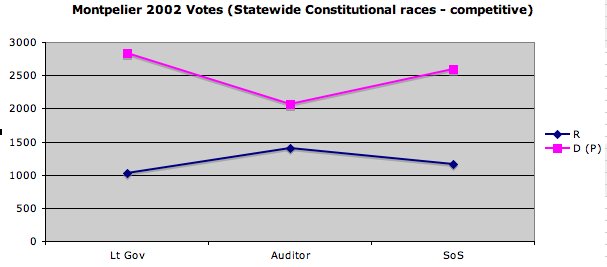
In this image, I’ve combined the votes for Pollina and Shumlin in the Lieutenant Governor column. On both the D/P and R ends, you see a very clear range. The Auditor’s race, I would argue, deviates from the range, as Elizabeth Ready was in the throes of her first scandal (the cell phone issue), and that took both her and her opponent out of their partisan baselines. I think the true baseline is a median line between Lite Gov and Secretary of State.

Now look what happens when we drop the Gubernatorial race in:
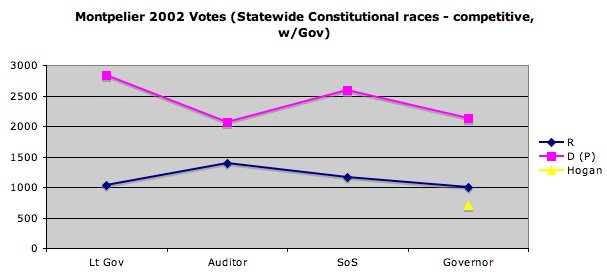
If the partisan baseline truly is the median between Lt Gov and SoS, it’s clear that Douglas stays within that zone (although barely), while Racine’s votes plunge right out – by an amount very close to the showing of Con Hogan.

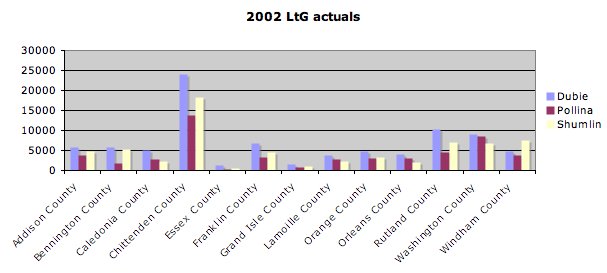
Now let’s look at the idea that Pollina can draw more from Republicans than Racine could. We looked at Pollina’s appeal to Republicans in this previous diary and saw that, while real, it’s manifestation in the ’02 Lieutenant Governor race was overstated. More importantly, though, is that it was clearly confined to the counties of Lamoille, Orleans and Caledonia. Here, again, are those numbers:
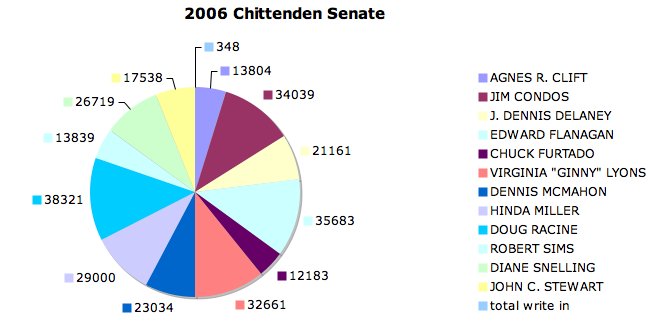
But Racine has his own regional appeal to Republicans – in the far more populace suburbs of Burlington, where votes would have to be mined in order to close the gap with Douglas statewide. In fact, as shown in this chart, Racine was the highest vote getter in Chittenden County this last election:
More to the point, however, is how well Racine recently did in the conservative enclaves outside Burlington – towns like South Burlington, Shelburne, Milton and Essex. The towns that have dragged on our statewide tickets in recent elections. As you’ll see from this chart, not only did he do well, he was also the highest vote getter in these four towns:
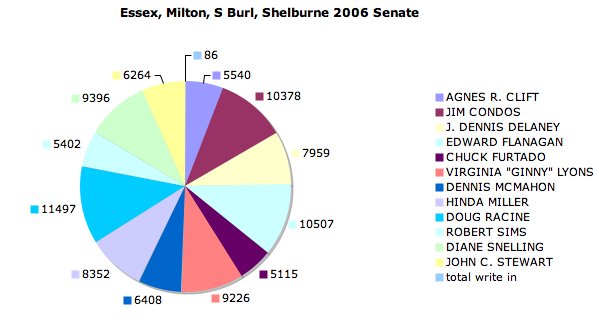
When Pollina ran for statewide office, he didn’t do so well there:
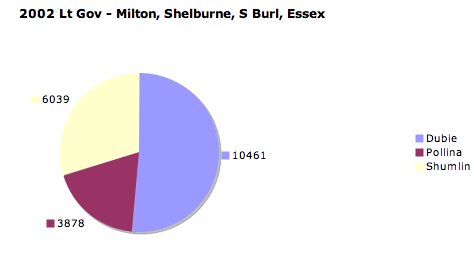
That’s means, in their most recent appearences in these swing towns, Racine collected a whopping 7619 more votes than Pollina did – even racking up 1580 more votes than Pollina and Shumlin combined. This is a bit of apples-to-oranges, as the Senate is a multiple choice ballot, but it shows Racine handily wins the popularity contest where Pollina didn’t by a significant margin.

Sure, you say, Pollina and Shumlin were running against Essex resident Brian Dubie.

Well, Racine has also run against Dubie – in the 2000 Lt. Governor’s race. Here are the numbers they posted in those conservative towns:
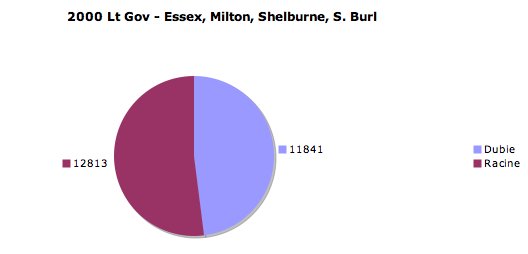
In fact, if you look at these numbers compared to his 2002 run against Douglas:
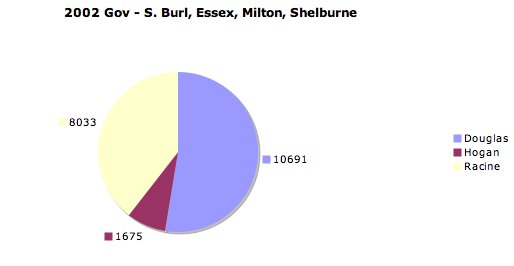
It seems likely that what everyone said was true: Racine underperformed, and hemorrhaged votes to spoiler Hogan, who hurt him badly.

But Douglas’s political star is clearly beginning to wane, with the recent WCAX poll showing, as I said at the time:

No two ways about it: the recent WCAX gubernatorial poll is huge. Here are Jim Douglas's re-elect numbers:

42 percent said they'd vote to re-elect Jim Douglas.

33 percent said they'd replace him.

25 percent said they were not sure.

Roper & company are trying to be blase about it, but this is a dramatic sea change. At this point in the last two cycles, Douglas's re-elect numbers were in the 60's. What's more ominous for the GOP is the significance of that number, which they no doubt recognize: 42%. It's roughly the mean, historical, hardcore GOP voting block that their statewides can depend on cycle after cycle. That's what he's down to, in terms of firm support.

…and in the meantime, with Racine posting higher numbers in these areas than ever in his career, his own cache with this group is clearly on the rise in a real, measurable way. The same cannot be mathematically demonstrated for Pollina, who has seemed to historically have very little interest in these areas. His limited strength in the northeast kingdom (and presumed increased numbers in Windham without Shumlin on the ballot) would be hard pressed to offset weakness in outer Chittenden, while simultaneously being expected to offset his questionable numbers in the rest of the state outside Washington County

Now any one of these arguments could be questioned. Racine was the popular incumbent when Dubie ran against him, while Dubie was the incumbent when Pollina and Shumlin ran against him. Time has passed since Racine was on a statewide ballot.

But when every argument mathematically suggests (if not truly concluding) on its face that Racine would be stronger, the individual “buts” start to lose meaning – and that’s because you’re looking at a trend. A systemic indication, and that becomes very hard to refute. And when you look again at the population spread, its clear that Chittenden County is where those votes are so badly needed, just as a matter of pure quantity. Pollina’s claim to a huge wave of support in Lamoille, Orleans and Caledonia counties is just too soft to offset the undeniable gains Racine would provide in suburban Chittenden, in my own opinion.

Racine’s appeal would cross from the liberal camp into that of the moderates, and there are many moderate business owners who would likely abandon Douglas for Racine, who they see as one of their own. Liberals would likely trust that Racine is on their side, even if he were to sometimes deviate from the liberal line. He, more than most, could hold together a left-center coalition, while Pollina would depend on a left-disaffected right coalition, Campbell and Galbraith would have a hard time establishing name recognition so late in the game, and Dunne would largely be an x-factor.

As I say, “electability” should hardly be the prime motivator in one’s choice of a horse to back. Hell, it maybe shouldn’t even make the top ten.

But don’t fool yourself about who has the mathematical mojo working for him among the current crop of pretenders, for whatever it’s worth.

Call Leahy and Sanders, Urge Them to Support the FISA Filibuster: UPDATED – Leahy’s mushy comments

UPDATE: TPM reports this disturbingly mushy response from our Senior Senator who is near the top of the list of Democratic Senators being disrespected and disregarded by Majority Leader Reid:

“The Senate should act to add protections for Americans’ rights that were not included in the Protect America Act. I have been consulting with Leader Reid and Chairman Rockefeller about how to proceed, and support the decision to proceed by regular order. Senator Reid is right to bring this legislation to the floor and is doing so in a way that allows consideration of the many improvements made by the bill reported by the Senate Judiciary Committee. I oppose retroactive immunity for the telephone companies that would eliminate the courts as a check on the illegality of the warrantless wiretapping of Americans that the administration secretly engaged in for almost six years. I will continue to work to ensure that the government is held accountable for its actions and that those whose rights were infringed not be left out in the cold. I look forward to a vigorous debate next week and to seeking to make the final bill considered by the Senate as good as it can be.”

Sounds to me like Leahy is laying the groundwork for looking the other way. The fact is, anything short of supporting Dodd’s filibuster is double-talk that should be considered insulting to Vermonters’ intelligence. ( /update)

I hate the celebrity political-blather thing. And I also hated The West Wing (yeah, that’s right, Sorkin’s a poseur who wouldn’t know a real leftist if they laid down in front of his Hummer singing “We Shall Overcome”… so sue me), but if you won’t listen to me, maybe you’ll listen to this West Wing guy:

This may have to be, not your garden variety, vote-against-cloture filibuster, but a good old fashioned, Hollywood, talk-it-to-death and embarrass the leadership filibuster.

Because the problem here, again, is the leadership. Majority Leader Harry Reid, who has upheld the tradition of individual Senators placing holds on legislation on behalf of the craziest Republicans like Oklahoma’s Tom Coburn (who still has a holds on bills, such as the one that would help prevent suicides among veterans), has decided to essentially spit in the eye of Democratic Senator Chris Dodd and ignore his hold on the FISA bill.

What’s wrong with the FISA bill? Well, the one that came out of the Senate Judiciary Committee isn’t quite as bad, as Senator Leahy stripped the provision that allows for retroactive immunity of telephone companies that broke the law doing Bush’s bidding on warrantless wiretaps of American citizens – but for whatever reason, Senator Harry Reid is bound and determined to get his campaign contributors their immunity. Can’t imagine why (/snark).

This cannot stand. And as far as I’m concerned, it’s the last straw for Harry Reid, who has lost any and all moral authority to lead the Senate. He needs to be out on his ass, the sooner, the better. I hope to god somebody finds a primary challenger for him in Nevada.

Contact info below the fold…

Here’s the contact info for Sanders and Leahy:

The Honorable Bernie Sanders

United States Senate


332 Dirksen Senate Office Building

Washington, D.C. 20510-4503

DC Phone: 202-224-5141

DC Fax: 202-228-0776

District Offices:

1 Church Street, 2nd Floor

Burlington, VT 05401 Voice: 800-339-9834

FAX: 802-860-6370

Burlington office

36 Chickering Drive, Suite 103

Brattleboro, VT 05301 Voice: 802-254-8732

FAX: 802-254-9207

Brattleboro office

2 Spring Street, Suite 1

Montpelier, VT 05602 Voice: 802-223-2241

FAX: 802-229-5734


The Honorable Patrick J. Leahy

United States Senate


433 Russell Senate Office Building

Washington, D.C. 20510-4502

DC Phone: 202-224-4242

DC Fax: 202-224-3479

Email Address: senator_leahy@leahy.senate.gov

District Offices:

199 Main Street, 4th Floor

Burlington, VT 05401 Voice: 800-642-3193

87 State Street, PO Box 933

Montpelier, VT 05602 Voice: 802-229-0569


And here’s how to contact Senators Obama, Clinton and Biden, all of whom have said they would support Dodd’s filibuster (we’ll see…)

Obama campaign: (866) 675-2008

Clinton campaign: 703-469-2008

Biden campaign: (302) 574-2008


And finally, here’s Reid’s contact info. Give him a piece of your mind, if you’re so inclined:

The Honorable (sic) Harry Reid

United States Senate


528 Hart Senate Office Building

Washington, D.C. 20510-2803

DC Phone: 202-224-3542

DC Fax: 202-224-7327

Email Address: http://reid.senate.gov/contact…

Who is “Utopian Wireless Corporation” and why should you care?

Well, that’s an interesting question.

I posted about this in June, and this morning I decided to do some follow-up, so I posted a thread over at Daily Kos:


There was an article in the Rutland (Vermont) Herald last June which was probably ignored by everyone but me.  In Vt. probes sale of broadcast spectrum, the Herald notes that the Vermont State Colleges did a no-bid deal with Utopian Wireless Corporation which the state is questioning, as it appears that the licenses are worth a lot more than Utopian paid for them:

“We estimate the value of these EBS license to be in excess of $500,000,” Smith wrote. “Vermont is home to numerous wireless broadband companies that are working hard to meet our rural broadband goals. Many of these companies are desperately seeking out licensed spectrum that will ensure their company’s future. It appears that Utopian’s mission is purely speculative in nature, with hopes of selling those assets to a larger national provider. It is unlikely that a national provider would have Vermont as a priority for building a wireless broadband network.”

After the fold, I’ll continue my Kos dairy plus add some comments about what I’ve found out since posting it.

There are some obvious questions here about the propriety of the no-bid contract and the financial issues, and that’s was the focus of the Herald article.  However, I’m much more interested in another aspect of the story.  Who is “Utopian Wireless” and what are they after?

I tried finding out about Utopian Wireless and came up blank, except for one interesting fact: they appear all over the country in meeting minutes from local school boards which are discussing similar deals: buying wireless networks from local school districts.  Web searches for Utopian yield nothing in the way about the corporation, who’s in it, no way of verifying whether any of the officials involved in these transactions have any connection to the company, etc.

Here are some examples:

Pangburn School Board:

NEW BUSINESS:  Mr. Wood informed the board that Utopian Wireless Corporation, a Delaware corporation (“Utopian”), would like to enter into an ESB lease agreement with Pangburn School District for the B channel group in Searcy, Arkansas, call sign WND586.  This matter will be tabled at this time.

Jasper  (IL) (link to pdf file):

Motion by Wes Pitcher, second by Gordon Millsap to approve the Education Broadband Service Lease Agreement with Utopian Wireless corporation as recommended. Ayes: Richards, Millsap, Pitcher, Huddlestun, Barthelme, Allison, Weber. Nays: None. Motion carried.

Also, the FCC has a daily release of transfers.  One from September 17, 2007 shows several transfers of leases involving Utopian Wireless that suggest a transfer from a Denver school as well as a couple other entities.

So while I don’t know who they are, I do know they’re not local to Vermont (they appear to be from Delaware), and I think that there’s real question as to whether or not a state entity should be making choice deals with out-of-state businesses without even giving local companies a chance to bid on the deal.  It could end up happening that Utopian just turns around and sells the networks to someone else for a profit, a profit that could have stayed in Vermont’s hands.  I’ve tried my best at sleuthing this out in Vermont and came up with nothing.  

There is a website — http://utopianwireless.com — that may or may not be connected with this company.  It’s a stub of a site without any real content and no contact information, a bookmarked “coming soon” site from Network Solutions, which tells us nothing.

Here’s why I’m interested: I don’t know who these people are but I know they’re doing deals by approaching local school systems, many of whom are strapped for cash.  I don’t know if they’re making good deals or bad deals, but I know they’re making deals and expect some profit off of those deals and I want to know what their intent is: to do some good for schools while making a profit?  To make a profit at the expense of schools?  I just don’t know and I’m having real trouble finding out anything.

So I’m hoping maybe some other Kossacks have a clue about this.  I know this is a long shot, and for all I know, this diary will die within minutes after it’s posted, but I figure it’s worth a shot– anyone have a clue as to who this company is and what they’re all about?  


Okay, so here is what I learned since posting that:

  1. WHOIS info suggests that Utopian Wireless is owned by RJGLaw LLC, a law firm which works with telecomm companies;
  2. SEC info suggests that this company is connected with Clearwire, a company which is summarized by this comment from Jessical on Kos: “They basically go in, blanket an area with marginal routers, and then hard sell “instant connect, wireless broadband internet”.  On Capitol Hill in Seattle, they actually come up and attempt to get signups on the street;”

  3. Clearwire is, apparently, connected with Craig McGraw, a guy who hosts great big pro-Bush events in Colorado every couple of years;

So this is what it looks like: VSC turned over their lease to an out of state company for lot less money than that lease was worth, so that that company could try to make a profit selling sub-standard service to Vermonters.  

Great.  Just… great.

I’m very curious to see how this plays out, but in the meantime, keep the name “Clearwire” in your minds.  If you see it pop up in your area, let me know.  

Paul Krugman’s “After the Money’s Gone”: Mortgage Crisis Redux


“It's a wholly rational panic.” 

In today's NYTimes OP-Ed, Krugman informs us that the Fed on Wednesday attempted to rescue the financial system for the fourth time in five months via a $40 billion loan to US banks.

4 rescue attempts in 5 months?  This is starting to look like a polar bear trying to find another melting chunk of ice to rest it's limbs on.

Reading Paul Krugman's ongoing assesments of the mortgage crisis can be a lot like watching “An Inconvenient Truth”, minus the package appeal.  Krugman pens an evolving, complicated, abstract story of high finance in the form of a serial op/ed in the New York Times.  Conversely, AIT's 90 minute Hollywood docu-drama about imminent climate change is accesible from a fold-down theatre seat with buttered popcorn readily available.

While it just isn't practical to eat popcorn while purusing Krugman on line, it might be a good idea to replace your cup of regular Joe with a good strong soup-bowl of Dark Magic Espresso Blend — hold the cream and sugar — 'cause it looks like it's gonna take some hoo-doo dark magic from the inner workings of the Fed, Wall Street, and foreign backers to kick our economy back in gear.

Everything — even complicated things — are easier to comprehend from the perspective of history.  Here's how I hope the story is told:  “How 13 million suburban home defaults ALMOST knocked over the US financial system — and how American fortune survived a staggering financial crisis.

Even if you're not an Econ 101 kinda person, this is something we all need to pay attention to — because it's not just about homeowner defaults.  The evolving financial crisis is on the cusp of evolving from a “mortgage crisis” to a large-scale banking meltdown. For those of us who are thinking about growing Vermont's economy, don't count on lending liquidity anytime soon.

“After the Money's Gone” is well worth the time it takes to read.  But just in case you don't click the link, here's the crux of the essay, minus Krugman's  easy-to-understand lead-in regarding investor confidence, the consequence of handing out bad loans, and the dynamic of a good 'ol run on the bank.

Enjoy.  And maybe you better get the popcorn after all.

It’s easy to get lost in the details of subprime mortgages, resets, collateralized debt obligations, and so on. But there are two important facts that may give you a sense of just how big the problem is.

First, we had an enormous housing bubble in the middle of this decade. To restore a historically normal ratio of housing prices to rents or incomes, average home prices would have to fall about 30 percent from their current levels.

Second, there was a tremendous amount of borrowing into the bubble, as new home buyers purchased houses with little or no money down, and as people who already owned houses refinanced their mortgages as a way of converting rising home prices into cash.

As home prices come back down to earth, many of these borrowers will find themselves with negative equity — owing more than their houses are worth. Negative equity, in turn, often leads to foreclosures and big losses for lenders.

And the numbers are huge. The financial blog Calculated Risk, using data from First American CoreLogic, estimates that if home prices fall 20 percent there will be 13.7 million homeowners with negative equity. If prices fall 30 percent, that number would rise to more than 20 million.

That translates into a lot of losses, and explains why liquidity has dried up. What’s going on in the markets isn’t an irrational panic. It’s a wholly rational panic, because there’s a lot of bad debt out there, and you don’t know how much of that bad debt is held by the guy who wants to borrow your money.

How will it all end? Markets won’t start functioning normally until investors are reasonably sure that they know where the bodies — I mean, the bad debts — are buried. And that probably won’t happen until house prices have finished falling and financial institutions have come clean about all their losses. All of this will probably take years.