In case you haven’t heard, there’s finally a Vermont Presidential poll (UPDATED)

From ARG, via the Freeps (h/t to Wes, as I’d totally overlooked this. So much for my Google alerts…):

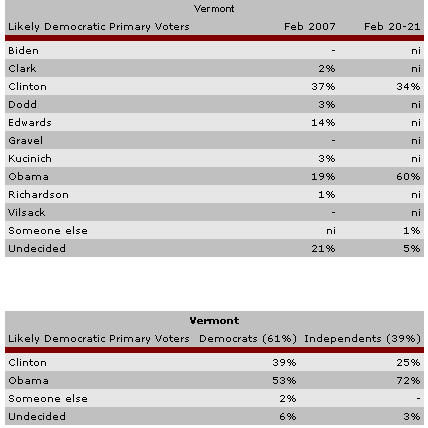
The poll numbers show Obama with 60 percent support among Democrats and independents planning to vote in the Democratic primary. Clinton had 34 percent and the remaining 6 percent was either undecided or favored someone else.

Raise your hand if you’re surprised.

Details after the flip, if you’re into that sort of thing.

Here’s the breakdown (compared to a poll a from a year ago) the ARG site:

Sample Size: 600 completed telephone interviews among a random sample of likely Democratic primary voters living in Vermont (364 Democrats and 236 independent voters and Republicans).

Sample Dates: February 20-21, 2008

Margin of Error: ± 4 percentage points, 95% of the time, on questions where opinion is evenly split.

Question Wording:

If the 2008 Democratic presidential preference primary were being held today between (names rotated) Hillary Clinton and Barack Obama, for whom would you vote – Clinton, Obama, or someone else?

Would you say that you definitely plan to vote in the 2008 Democratic presidential primary, that you might vote in the 2008 Democratic presidential primary, or that you will probably not vote in the 2008 Democratic presidential primary?

Now, you just gotta love polls like this that take no understanding of statistics or polling or any other arcane stuff to be able to read. Just look at the change between Clinton’s and Obama’s counts over the year.

Clinton’s support remains a constant, within the margin of error. People who wanted to see her President last February haven’t changed their minds a whit.

And the same is true of Obama supporters. The difference is that Obama has managed to scoop up everybody else: the Edwards supporters, the undecideds… hell, even the Kucinich supporters.

It’s hard to imagine that everybody else so neatly lines up with Obama. In fact, it’s easy to demonstrate that many of them (such as the Kucinich supporters) don’t. ALl things being equal, the distribution of those voters should have been more evenly divided.

Which means that that increase has to be read as a repudiation of Clinton, as much (or more) than an embrace of Obama. In Vermont, the election has sorted into what many thought it would in the rest of the country: the Clinton supporters versus the non-Clinton supporters (beyond Obama’s initial 19%, which undoubtedly were more “pro-Obama” than “anti-Hillary”).

Obama, as the last “un-Clinton” standing, has reaped the benefits.

As H.304 Predictably Fizzles, Can We Imagine an “Efficiency Vermont” for Healthcare?

Of all the ruts the Vermont left seems to be in, the policy rut seems to be the most problematic. There are tremendous upsides to living in such a small state, where political interactions are generally more personalized affairs than in other arenas, but among the downsides is the political stereotyping – or perhaps archetyping – that happens. People slip into roles, and often seem to simply go through the motions in acting out those roles time and time again on the political stage.

Case in point, the needless tragedy that is the failure of H.304, which would have set up the State of Vermont to become the functional single insurance payer for Hospital care, in an attempt to jumpstart the transition to a single-payer system. As many on the left opined (myself included), 304 was a bad bill, poorly conceived, supported and understood – and as such doomed to failure as written. It was, however, the first meaningful, tangible attempt to make a real first step in the single-payer attention, and as such deserved more than to be unceremoniously dumped. Unfortunately, neither its supporters nor legislators were interested in making any progress, so immersed as they were in playing their respective, traditional roles.

For the legislators, that simply meant throwing up their hands because it was too hard. Now, this is a “citizen” legislature with limited time and support, and who depend on the executive branch to flesh out the legal nitty-gritties of whatever they pass, programmatically, so I have some sympathy given all that they’re asked to do – but still, there is no more important issue period, so the time must be made. This bill should have been taken on and at least discussed as a serious starting point.

And for the activist/supporters, it meant virtually phoning it in. A half-baked bill that makes it hard to believe they expected it to get a serious hearing. A public support campaign which cavalierly insulted people, rather than spoke to them, and a harsh unwillingness to accept any criticism. I received a rather unpleasant email from someone who, by their email address and “behind-the-scenes” take on  things, was clearly a Vermont Health Care for All insider. Let’s just say it was anything but open to criticism from anyone – even someone who publicly supports their cause. And the display in the Statehouse was even worse. When met with incredulity from serious lawmakers looking at the partially fleshed-out revolutionary overhaul of the system, many of the same, usual activist suspects just fell back on their old roles and chastised even friendly legislators like Senator Racine (D-Chittenden) and Representative Maier (D-Middlebury). It was as though they were covering their ears and going “na-na-na-CAN’T-HEAR-YOU-na-na-na” to even ideological allies who were merely skeptical about this particular approach.

The final result, predictably, seems to be a big fat nothing. Everybody going through the motions, and nobody surprised by the outcome. Is it possible that we need not only some fresh faces in the legislature, but also some fresh faces among the activist community?

Let’s talk solutions after the fold…

As GMD commenter SPS pointed out at the time:

My concern with this bill is the incentive structure it may put into play for many Vermonters with high-deductible insurance.  Basically, if a person needs to go to the doctor, but has a $3000 deductible, s/he is likely to try to go to the emergency room to try to take advantage of this benefit and avoid the deductible charge.  It encourages people to use the most expensive part of the health care system for relatively simple problems.  Maybe I am reading it wrong, but that is what it sounds like.

It might make more sense to start single-payer on preventative and chronic care side.

Agreed. But how?

The most successful progressive program in Vermont is arguably Efficiency Vermont. Efficiency Vermont is run through a private nonprofit and “provides technical assistance and financial incentives to Vermont households and businesses, to help them reduce their energy costs with energy-efficient equipment and lighting and with energy-efficient approaches to construction and renovation.” The concept is that the program and its recommendations, if implemented, conserves energy (across the state and for individual users), as a result bringing a user’s utility costs down by a certain amount, while getting funded with a charge on that bill that creeps it back up by far less than the savings provided by the program itself, maintaining a significant net decrease in consumer costs while perpetuating itself financially.

Could you do that with health care?

It’s not a clean fit, but it could be rhetorically powerful if you could make a programmatic approximation. It’d make the concept a much easier sell to a public (and to a legislature) which has grown comfortable with the Efficiency Vermont model.

Here’s a shot at it:

  • Create a privately managed and administered network of providers to provide a set list of basic, preventative care procedures (e.g. health screenings, mammograms, and basic health maintenance including blood testing – possibly even inexpensive medicines for conditions like diabetes and hypertension. Some of the most common medications for those conditions are actually pretty inexpensive). Or, better yet – retrofit the already existing Catamount system to handle it…
  • Have these procedures for Vermonters in the program paid for by the new state authority.
  • Modify community rating so that signing onto the program can be considered by private insurers in setting rates. Mandate that Vermonters on the program must have their premiums reduced or rebated by a certain percentage.
  • Pay for the program through a surcharge on health care premiums – but one far less that the premium reduction afforded for joining the program, leaving a significant net savings for the consumer in place.
  • I would consider making the program as financially stable, predictable and manageable as possible, maybe by surveying how many Vermonters are likely to participate and giving participating providers block payments, rather than having them bill each individual procedure. If a doctor reaches the limit of what they’ve been block granted, an effort can be made to direct patients to another nearby doctor who isn’t so maxed out – and of course if that isn’t possible (or there is no other nearby participating provider), the state can start covering procedure by procedure. The block grant approach could have the added effect of further cutting into the clerical costs of health care. Of course, it would also make for some heinous end-of-year reporting requirements, but it’d still be less paper work than billing every individual procedure to the state. Perhaps a special recording/accounting/reporting software package could be standardized for participating providers.

Hopefully, such a system could be rigged to largely pay for itself, while bringing down premiums for individual Vermonters – again, mirroring Efficiency Vermont. There would be broad payoffs at the community level as well, as the health care costs impacting town budgets and local businesses could be noticeably effected.

One of my favorite elements is the idea that we wouldn’t be counting on all the mystery money saved by reduced paperwork and early treatment. Over the last couple decades, there has been a game of activist telephone played on those numbers. Somebody gives a ballpark estimate of x-many-millions that could be saved, that gets picked up, repeated, passed around – and then gets promoted as a firm value that budgets can be predicated on, which is nuts. There are guesses and speculations, but nobody can say for sure how much will or won’t be saved from such changes. In this system, we wouldn’t be depending on such phantom numbers. Those savings would simply present themselves – whatever they may be – and we can work with them from then forward.

It would also get more people comfortable with the idea of the state brokering their health care, and would be a meaningful way to grease the wheels towards single payer, should we ever get enough flexibility from the feds to go that far. As I’ve stated before, for such a transformational change as a single-payer health care system, there has to be enough buy-in from the general electorate to support taking the plunge, come what may.

Under such a program, it might end up making even more sense to a broader range of Vermonters for all the ethical, commercial and practical issues the rest of us talk so much about.

So – your turn. How might you make tangible steps into a single-payer world? Throw your ideas out there, or tear mine to shreds… or both.
What Part of “Affordability” Doesn’t Jim Douglas Understand?!

(Good diary. – promoted by JulieWaters)

… I guess it’s the “ability” part. Douglas is rightly being criticized for gutting money for the housing and conservation board in his budget. That’s money set aside for land conservation and affordable housing in Vermont. Gov. Dean always found money to put into VHCB (the Vermont Housing and Conservation Board, which administers the Vermont Housing and Conservation Trust Fund) because he knew that Vermonters value the land, that it would help family farms, and that it created opportunities for Vermonters to put a roof over their heads at reasonable cost. But, it’s not just advocates objecting to these short-sighted cuts. Legislators are catching on as well.

Read Vermont Land Trust Past President, Darby Bradley’s excellent op-ed here: http://www.rutlandherald.com/a…

And, another good one from Sen. Jim Condos here: http://www.burlingtonfreepress…

Finally, here’s one from Kim McCarty of the Vermont Center for Independent Living: http://www.burlingtonfreepress…

So what exactly is Douglas proposing? How about a 30% (or $5 million) cut in funding. That represents a loss of 120 affordable housing units, and saving 10 family farms and 10 community conservation efforts.

According to the Vermont Land Trust, “in the past 20 years, VHCB investments in Vermont communities have created more than 8500 permanently affordable homes and apartments and conserved more than 500 farms and 250,000 acres of forests and natural areas. For two decades, this has all made sense because affordable housing and conservation have strengthened our communities, conserved our world-class landscapes and in turn advanced our economic vitality.”

This is Douglas’ idea of promoting “affordability”?! Sounds more like throwing the baby out with the bathwater.

Maybe his public service announcement (ironically titled “Stretch Your Limits”) should be retooled for Vermonters whose economic limits are being stretched. He doesn’t even have to change his lines: “I’d like to challenge all Vermonters [sic] to stretch their limits this winter… then write to me and tell me how it’s helping you…” If you want a chuckle, you can check Slim-Jim’s PSA over at YouTube: http://www.youtube.com/watch?v… (thanks to Nancy Remsen of the Free Press for posting the link over at VT Buzz).

Hmm. Not a bad idea. Why not write Jim Douglas and tell him how his so-called “affordability” agenda, and that of his friend George W. Bush, is stretching us all to our limits (one new report out today even shows how Americans are tapping their retirement funds today in order to get by). The GOP agenda has helped us to record high gas and home heating oil prices; skyrocketing housing and rental costs; inaccessible and/or unaffordable health care, and skewed budget priorities that help the most affluent but do little for the rest of us.

While Douglas has routinely campaigned on, and championed, this agenda Democrats should hang this around his neck like the albatross it truly is and make him pay for his empty promises. If we don’t we’ll all be paying for it for years to come.

How about this for a Democratic coordinated campaign message: “Are You Better Off Now Than You Were Six Years Ago?” (with apologies to Ronald Reagan… Obama was right, he did have some good ideas!).

cross-posted at http://mulishbehavior.blogspot…

Vermonters for Gore? (UPDATED)

Is there another candidate emerging in the presidential race in Vermont?

About a week ago I got a letter at home from Farrell Seiler, who describes himself as the Vermont Write-In Coordinator for Draft Gore USA.  The letter calls for a write-in campaign on Town Meeting Day to “show te nation that there is huge support for [Gore] at the grassroots. A large voter turnout for Al Gore is the quickest way to show America that Democrats already have an electable candidate for president.”

The letter refers you to the campaign's web page, www.VermontersForGore.com, and the credit line says it's paid for by Draft Gore USA, listing its web page as DraftGoreUSA.com.

Let a hundred flowers bloom, right?

The problem is, none of the URL's listed in the letter get you to anything but a “site under construction” page.

Maybe Vermont really isn't ready for a Gore write-in campaign.

Or maybe this is another sign to stay in the world of reality. 

I've posted an email to the guy who signed the letter, and I'll let you know what I find out. 

UPDATE: I heard from these guys this afternoon. Here's the link to their site, and it's no longer under construction: http://www.vermontersforgore.com/ 

Plagiarism … to be or not to be …

that certainly is the question.

From The New Oxford American Dictionary:

the practice of taking some else’s work or ideas and passing them off as one’s own.

(No way am I going to claim credit for that definition … I’m no plagarist.)

I want to move beyond the irony of a bunch of pundits using pre-distributed talking points to beat up on Obama for “plagiarizing” a few words shared by and with friends (and even others maybe).

I want ask a question: where did Obama claim credit for coming up with the phrases and ideas he’s being accused of plagiarizing? Maybe I’m wrong, but I can’t seem to find Obama saying “This idea, which is all my own, … ”

If Obama is plagiarizing then we all are plagiarist. After all every concept I have is built upon previous knowledge.

So I think the pundits who spend their days being plagiarists with pre-supplied talking points should just shut up … they’ve proven to be profoundly non-useful anyway.

Town meeting and fiber-optics

Important meeting date for Williamstown follows below:

On town meeting day folks in Williamstown and many other communities will get a chance to weigh in on a crucial community infrastructure.

ECFiberNet (http://wwwECFiber.net) is a bottom up, ad-hoc citizens committee (sometimes) officially and (sometimes) unofficially representing towns and cities throughout Orange County and beyond. We are proposing to our communities a modern, fiber to the home communications system that will provide video, audio and data services … television, phone and internet if you will … but that may oversimplify the issue.

The upshot is many of the involved towns will be voting on a non-binding resolution giving community blessings for their select boards/city councils to enter into an interlocal agreement that will oversee design, build and management of this system.

A great analogy for the ECFiberNet project is our highways. Essentially you can use the public roadways for whatever purpose you wish: personal or business. All you need to do on our highways is pay your fair share via various taxes and fees.

ECFiberNet’s proposal is not asking for any tax dollars. The system is designed from the bottom up to be funded entirely by subscribers … and of course all service subscription is voluntary.

This fiber to home system is being designed to make itself available to literally every home and business in every participating community … no exceptions! The system will be open to any and all even if somebody is offering services that will compete with ECFiberNet’s core offerings. There is so much bandwidth (nobody knows the upper limit) that free or near free non-profit or community based television/radio broadcasting is being envisioned.

There is so much more to this project. Please visit http://www.ECFiber.net to read what the hubbub is all about.

Williamstown will be holding an informational meeting on the ECFiberNet proposal and accompanying town meeting day question this coming Wednesday, February 27th. The meeting will be in the Williamstown high school library and run from 7pm to 9pm.

If you are yourself or you know folks from Williamstown please help spread the word to them.

Brattleboro Adopts Taser Reform

Per the Rutland Herald:

Police officers will be able to use stun guns, marketed and sold under the brand name Taser, to defend an officer or a third person from what is believed to be an immediate threat of physical injury, Sondag said, or to prevent a suicide or serious self-inflicted injury.

But stun gun should not be used against anyone demonstrating passive resistance, she said. The device should not be used as a prod or in a punitive way, she added, or to rouse an intoxicated or unconscious or impaired person.

It’s almost like the policy is, you know, sane.  Or something.

Psst ,wanna buy a State Lottery …cheap?

 Gov.Jim Douglas may have counted his chickens before he layed his bet!

Times Argus

Article published Feb 21, 2008

Wall St. analyst: $50M from lottery is too high

By Dave Gram Associated Press

MONTPELIER – A Wall Street investment banker told Vermont lawmakers Wednesday the $50 million Gov. Jim Douglas hopes to reap from privatizing the state lottery is overly optimistic.

J.P. Morgan Managing Director Jeffrey Hyman, speaking to the House Ways and Means Committee, didn’t give a specific number for what the state of Vermont could expect if it bets on Douglas’ plan to lease the lottery to private investors for 40 years.

But written materials that J.P. Morgan provided to lawmakers said a $10 million a year “revenue upside could equate to an additional $35 million in value.”

Douglas, citing an earlier report from another Wall Street investment house, Lehman Brothers, said the state should expect a one-time, upfront payment of $50 million, plus annual revenues at least equaling the $23 million a year Vermont now reaps from its lottery.

He has proposed splitting the $50 million between reducing the statewide property tax and helping local school districts pay for construction projects.

Hyman noted that the securities markets have been shaken in recent months by the subprime mortgage crisis and other developments, leaving many investors less able to borrow money that likely would be needed to take over a state’s lottery.

“The leveraged finance world has been under a lot of stress for the last six to nine months,” said Hyman, who suggested two other strategies the state might pursue:

# A business study that would look for ways to “extract more value” from the lottery through a combination of increased ticket sales, greater efficiency in operations or some other strategy.

He said taking some of those steps before looking for investors to get involved in the lottery could increase its value. “The savvy seller will paint the house and clean up the yard and get that extra 10 percent kick,” he said.

Hyman said hiring a business consulting firm to look for ways to get more bang from the lottery might cost the state $100,000 to $200,000 for a team of consultants to work for two months.

# Issuing bonds, to be paid back with future lottery revenue, which might be more lucrative deal and give the state more control, Hyman said. Tax-exempt bonds might be a more attractive investment vehicle to some investors, he said.

Committee members listened but took no action Wednesday.

After the meeting, committee member Rep. Jim Condon, D-Colchester, said he thought Douglas had jumped the gun in counting on the money from the earlier estimated $50 million to pay for school construction.

“I think it was a little premature for him to build that into the budget,” Condon said.

But Douglas defended it, saying the Senate Institutions Committee was building a new capital construction budget that didn’t count on the lottery lease money.

“It’s not really built into the budget,” he said.

N.H. Republican Drops WC Bomb on Bush/Cheney During House Impeachment Hearing

by Dan DeWalt

In a packed hearing room on Feb 19th, under a carved wooden sign reading “Live Free or Die”, the New Hampshire House committee of State-Federal Relations and Veterans’ Affairs heard testimony on Representative Betty Hall’s HR 24, which calls on the U.S. Congress to begin impeachment hearings for George W. Bush and Dick Cheney.

What was most notable about the four straight hours of testimony was not that opponents of the resolution could only muster two people willing to testify against it, both Republican stalwarts using selected excerpts from Jefferson’s parliamentary manual or from the bill itself, whose arguments were embarrassingly empty.

It was not that Kris Roberts, the committee chair, had taken this hearing seriously enough to have researched the law, history and nuances of the subject, and that he used this to inform the proceedings in a reasonably fair manner.

It was not the fact that after the hearing ended, several pro-impeachment witnesses were approached by committee members and thanked for their clarity and useful testimony.

It was not even the novelty of the interjections by one committee member that would periodically steer the conversation abruptly into Rockefeller/Trilateral Commission territory.

The most remarkable moment came late in the afternoon when Republican House member Steve Vaillancourt strode into the room to testify. After passing out copies of the second chapter of Patrick Buchanan’s “Day of Reckoning” as supporting evidence, Vaillancourt opened his remarks quoting “fools rush in where wise men fear to tread”, and it sounded like a set up to condemn a rush to impeach. But instead he said that Betty Hall is neither fool nor wise man, but is a model of courage and that her impeachment resolution should be supported.

And then the fun began.

Member Vaillancourt then gave a short history lesson, telling the committee that until Bush/Cheney, America had never engaged in an offensive war [sic.], and pointing out that the Truman, Eisenhower. Kennedy and Reagan “Doctrines” had all been based on defense and had not been offensive in nature. Warming to the subject, he delved into the ramifications of Bush/Cheney’s actions, saying that their reckless foreign policy has been anti-American, unconstitutional, and ruinously costly to the nation.

He was fairly thundering by the time that he pronounced that not only should Bush and Cheney be impeached, but also they should be tried as war criminals in a Nuremburg style trial for crimes against humanity. He flatly stated that the war in Iraq has provided grounds for war crimes charges against the President and Vice President. And there was not one word of protest from a single committee member. They may or may not support this resolution to impeach, but there seems to be no one left with a credible argument to defend Bush/Cheney.

Vaillancourt said that he spoke not as a Republican, a New Hampshire citizen or an American, but as a member of humanity. His remarks made a common sense plea for an honest appraisal of our current political situation, for the acknowledgement that we have a duty to act as a decent and responsible people, and that principle be the governing factor of our government’s actions. These are all values that should, and once did, cut across party lines. If the current political parties have forgotten this, and become so degraded as to allow the lawlessness and criminality of this administration to go unchecked, the people have not.

And at that hearing the people had their chance to speak. One member of the committee remarked that she had never before seen such a wide range of viewpoints as represented by the witnesses, to be so united on one issue.

After deliberation the next day, loyalty to party leadership proved a stronger pull than reasoned argument, for five committee members voted to recommend the bill, with eleven voting against. Now facing  an uphill battle to get it passed in a full House vote in March, Betty Hall was still encouraged by the committee hearing and vote. She has received much more support for this resolution than she did with a similar effort last year, and is already working to get grass roots supporters out between now and the vote to get their legislators’ attention.

If the grass roots continue to pour out as they did on Tuesday, and if there were a few more politicians like Steve Vaillancourt and Betty Hall, we might see things begin to change. It’s instructive to remember that some politicians who are now leading the charge for impeachment did not want to talk about it only a few short months ago. The spotlight is now on the New Hampshire House, the third largest deliberative body on the planet, and arguably one of the more democratic representative systems anywhere as well. These representatives may listen to an outsider’s viewpoint on what to do about the Constitution, but they will be influenced most by the neighbors whom they represent. The question is, is New Hampshire angry enough and organized enough to convince the legislature to call for impeachment? For those outside of New Hampshire the question is, how can we raise the temperature everywhere else, making it all the more plausible that the Granite State will reach the boiling point.

It’s on

Consider this an addendum to Jack’s diary below.

Not only is there an Obama campaign office newly opened in Montpelier, there are also Obama offices in White River Junction, Bennington, and – of course – Burlington. Tonight there was an Obama event in Windham County hosted by Senator Shumlin, featuring former Clinton administration National Security Advisor (and current Obama campaign senior foreign policy advisor) Anthony Lake.

There are also at least three paid staffers for the Clinton campaign in Vermont, while high-profile Hillary supporters have already begun “grasstops” phone calls to progressive leaders – and there are rumors of a possible stop in Vermont by Chelsea Clinton.

We may not be Texas or Ohio, but it is nice to feel like your vote matters to someone after all, isn’t it?