War … huh … what is it good for?

Absolutely nothing … except making a bunch of money by hoodwinking folks across the country we have nothing to fear but a lack of fear itself. And in the process we leave any form logic and common sense behind.

Fifty-seven percent (57%) of U.S. voters nationwide favor a military response to eliminate North Korea’s missile launching capability. The latest Rasmussen Reports national telephone survey shows that just 15% of voters oppose a military response while 28% are not sure.

(57% Want Military Response to North Korea Missile Launch, Rasmussen Reports, 04/05/09)

Standing by, primed and ready to take advantage of this built in fear are the fear mongers …

Arguing that the U.S. faces a future gap in advanced, high-resolution imaging capabilities, Director of National Intelligence Dennis Blair and Defense Secretary Robert Gates last week asked the White House to approve plans to build a pair of large, cutting-edge spy satellites along with two smaller, less-expensive models commercially available today, these officials said.

(Satellite Proposals Gain Traction After North Korea’s Launch, Wall Street Journal, 04/05/09)

First off let’s put the most blatant bullshit lines to rest: North Korea did not launch a missile, they launched a rocket with a non-weapons payload, and we are no more in danger of some mythical satellite capabilities gap then we were in danger of those equally mythical Iraqi drones cheney/bush & co insisted were ready to be launched off our coasts to spray our women and children.

The more important point, however, is how we as a nation deal with those who are suspicious of us … even have been at war with us in the past and continue a relationship mutually based on a difficult to police armistice. Okay … call North Korea a paranoid nation if you wish. But you don’t bring paranoids into a common fold by threatening them.

Is North Korea a threat to anyone? Nope. It is that simple. North Korea has never invaded another nation. When the Korean war exploded in 1950, it was the result of both the north and south pushing for re-unification … under THEIR respective leadership … not that of the other.

North and South Korea hadn’t existed for more than half a decade at that point. Korea had been divided between the Soviet Union and the non-Soviet Union allies at the end of World War II, and by 1950 neither North nor South accepted that solution.

In the minds of the Koreans there was still only one Korea … period. So began a civil war.

Since the 1953 armistice that ended the Korean war, North Korea as a government has been content to keep its own population under control and maintain dictatorial power.

In that time North Korea has developed (with initial help from the Soviet Union and then China) a sophisticated home grown missile and rocket industry that has even proved itself capable of export. This is also true of their nuclear power/weapons know how.

And that last paragraph is the real answer to our current dilemma vis-a-vis Korea. We should be telling the North we will gladly join in and provide technical help to move their programs forward.

Any nation that has the capability to put a satellite in orbit, which North Korea is only a launch or two away from, is technologically advanced. This type of technological know how takes educated people, and educated people are open to new ideas when they get a chance to hear them.

As an aside I recommend this as our approach to Iran too.

As long as our approach to the North is as belligerent as their approach to us we will remain at a stalemate. We can’t attack the North without an overwhelming conventional response attack on the South. And if we get into a nuclear weapons pissing contest we all lose … literally.

We need to change our approach in a fundamental fashion … one that does not include useless threats or disastrous war.

Unless we want to buy that bullshit about some mythical “gap in advanced, high-resolution imaging capabilities” which will lead to more weaponry built by us which will lead to more suspicions on the part of North Korea which will lead to greater public acrimony which will lead to more military spending which sooner or later will lead to yet one more massive war built on the backs of the working class to enrich a few privileged money brokers …. which is what Washington DC seems all about today.

Courage is not the absence of fear; courage is the conquest of fear. We need to realize we are prepping ourselves for wholesale slaughters and destruction unless we overcome our fears and move into a future based upon courage.

On ratios, rejections and the numbers

First, a brief note of explanation: to override a veto, there must be 2/3rds of those voting and present to override.  This means means that if all 150 members of the house show, there is a necessary supermajority of 100 people who have to vote to override the veto of same-sex marriage by Governor Douglas in order for his veto to be successfully rejected (this applies to the house.  I’m not talking about the Senate because it’s pretty much a lock).

The vote last week was 95 – 52.  Among those voting yes, there were 5 Republicans.  Among those voting no, there were 11 Democrats.  

If we had only those 147 members voting for the override, we’d need 98 votes to make the 2/3rds.

But we know a few things.  First, two of the Democrats who voted against the legislation have pledged to vote in support of the override.  That means our numbers are more like 97-50.  We also, however, know that one Republican opposed to the bill will be there for the override, which means 97-51.  

We can’t rely on those five Republicans to support a vote to override their own governor, and we don’t know what those other nine Democrats will do.  

But what if the override vote didn’t involve the full house, but was fourteen votes short?  I.e., if any Republican who supported the bill but didn’t want to go against the governor didn’t vote?  And those Democrat who supported opposed [bad fingers!] the bill but didn’t want to get in the way of the leadership didn’t vote?  That’s 136 members voting in the override vote, which means that all we need to win is 91 votes.  If Audette and Evans both vote as promised (against the veto) and we let the five Republicans off the hook provided they don’t vote to support Douglas, if you take away those five Republican votes, you’ve still got 92, which means we win.

I’m okay with winning that way.  I’d rather win with a few Republican votes.  But I’m okay with winning without them.  We can do this as long as they stay out of the way.  

But seriously: if Democrats show up and vote to sustain Douglas’ veto here?  I’ll be beyond livid.  If they want to sit it out?  Fine.  Whatever works for them.  But they need to stay the hell out of the way.

Caribou Barbie–the gift that keeps on giving

Cross posted from Rational Resistance:

It's almost enough to make you wish she had been elected VP, isn't it?

Todd Palin's half-sister arrested for burglary

Posted by Alaska_Politics

Posted: April 3, 2009 – 12:00 pm

From Zaz Hollander in Wasilla:

Todd Palin’s half-sister was arrested Thursday after police say she broke into a Wasilla home for the second time this week to steal money.

Palin is the husband of Gov. Sarah Palin. He declined comment.

Governor Douglas Desperately Seeking Divisive, Distracting & Painful Court Battle – That He’ll Lose

On behalf of the State of Vermont, Governor Douglas is threatening to deny equal marriage opportunities to same gender couples.  This will have at least one of the following results.

1.  A long, drawn out, expensive, divisive, distracting, unnecessary, mean-spirited and painful for many Vermonters battle that he will eventually lose in the legislature, if not this year, then soon.

OR

2.  A long, drawn out expensive, divisive, distracting, unnecessary, mean-spirited and painful for many Vermonters battle that he will eventually lose in the Supreme Court next door to the State House.

Or

3.  The Governor will force “Number 1” which will lead to “Number 2” with the Vermont Courts, which will put us RIGHT BACK TO WHERE WE ARE TODAY and will require additional legislation to carry out the Court's order.

If the Governor goes through with his discrimination veto, he will inevitably force court and legislative battles. The Governor's pro-discrimination veto will send us — in 2010/2011/2012 — right back to the 2009 General Assembly.  Right back to the 2009 General Assembly that is, today, proudly standing with all Vermonters and protecting their rights. 

If the Governor chooses the path of division, delay, distraction and the disgrace of rejecting Vermonters' rights to marry — all of our rights as Vermonters and as people — to enjoy State created legal marriage benefits, then the following is a harbinger of what's to come. 

You did not read it here first, but you will read something like it soon enough if the Governor chooses goes through with his discrimination veto.

Back to the future, below: 

The Iowa Supreme Court eloquently addressed the issue of how its Constitution, just like Vermont's, protects the rights of citizens who want to enjoy the benefits of State created civil marriage. 

Quoted below is just a brief sample of the type of language we should expect to hear from the Vermont Supreme Court if Governor Douglass carries through with his discrimination veto against Vermonters.

Like Iowa's, Vermont's Constitution affords all Vermonters the right to civil marriage.  Here is what the Iowa Supreme Court had to say in response to the argument that marriage rights must be affirmatively denied to homosexuals by the State:

It is revolting to have no better reason for a rule of law than that so it was laid down in the time of Henry IV. It is still more revolting if the grounds upon which it was laid down have vanished long since, and the rule simply persists from blind imitation of the past .  .  . 

In the first reported case of the Supreme Court of the Territory of Iowa, In re Ralph, we refused to treat a human being as property to enforce a contract for slavery and held our laws must extend equal protection to persons of all races and conditions. This decision was seventeen years before the United States Supreme Court infamously decided Dred Scott v. Sandford, which upheld the rights of a slave owner to treat a person as property. Similarly, in Clark v. Board of Directors, and Coger v. North West. Union Packet Co., we struck blows to the concept of segregation long before the United States Supreme Court’s decision in Brown v. Board of Education. Iowa was also the first state in the nation to admit a woman to the practice of law, doing so in 1869. Her admission occurred three years before the United States Supreme Court affirmed the State of Illinois decision to deny women admission to the practice of law, see Bradwell v. Illinois, and twenty five years before the United States Supreme Court affirmed the refusal of the Commonwealth of Virginia to admit women into the practice of law, see Ex parte Lockwood. In each of those instances, our state approached a fork in the road toward fulfillment of our constitution’s ideals and reaffirmed the absolute equality of all” persons before the law as “the very foundation principle of our government.” []

. . . [T]his court . . . faces an important issue that hinges on our definition of equal protection. This issue comes to us with the same importance as our landmark cases of the past. The same-sex-marriage debate waged in this case is part of a strong national dialogue centered on a fundamental, deep-seated, traditional institution that has excluded, by state action, a particular class of Iowans. This class of people asks a simple and direct question: How can a state premised on the constitutional principle of equal protection justify exclusion of a class of Iowans from civil marriage?

And how does the Iowa Supreme Court answer this question, and what can we expect here in Vermont if the Governor forces an expensive, divisive and needlessly cruel and drawn-out court battle to secure fundamental equal protection for all Vermonters?  The end result will sound something like this:

From the Iowa Court —


[There is no] constitutionally adequate justification for excluding [homosexual Iowans] from the institution of civil marriage. A new distinction based on sexual orientation would be equally suspect and difficult to square with the fundamental principles of equal protection embodied in our constitution. [Defendants are unable to show] the existence of a justification for such a legislative classification [banning marriage rights] that [advances] any governmental objective. Consequently, the language in [the Iowa statute] limiting civil marriage to a man and a woman must be stricken . . . and . . . must be interpreted and applied in a manner allowing gay and lesbian people full access to the institution of civil marriage.

Relative to the Iowa defendants' argument that some couples in Iowa should be denied the marriage rights of other couples, the Court went straight to the point and declared that the State's Constitution – like Vermont's – is there to defend the liberty of the State's residents. Constitutional democracy does not exist to “protect” the prejudices of those who would deny equal right, equal liberty and equal legal protection to their neighbors. 

Once again, you did not hear it here first, but if Governor Douglas carries through on his threat to issue a discrimination veto and creates a long, divisive and unnecessarily mean fight, the will ultmimately and needlessly be thrown at the Courts for the resolution, which is already that is sitting on his desk, then here is a taste of what the Vermont Supreme Court will say about the Douglas' “legacy:”

From the Iowa Supreme Court — 

This lawsuit is a civil rights action by twelve individuals who reside in six communities across Iowa. Like most Iowans, they are responsible, caring, and productive individuals. They maintain important jobs, or are retired, and are contributing, benevolent members of their communities. They include a nurse, business manager, insurance analyst, bank agent, stay-at-home parent, church organist and piano teacher, museum director, federal employee, social worker, teacher, and two retired teachers. Like many Iowans [and like many Vermonters], some have children and others hope to have children. Some are foster parents. Like all Iowans [and like all Vermonters who do not subscribe to illiberal discrimination], they prize their liberties and live within [Iowa/Vermont] with the expectation that their rights will be maintained and protected . . .

Please take time to read the entire decision Varnum v. Polk Co. Dk't 07-1499 (Iowa 2009).

Homophobia story suspended

Earlier today we posted a story about homophobia in a Canadian nursing program. Because questions have arisen concerning the veracity of the story, it has been taken down until we can be more comfortable with the facts as originally reported.

Hostage to the Markets

Since the 1980’s the financial industry has done a good job lobbying Washington for regulatory and tax changes that have made Wall Street the de facto retirement system for our nation.  Today,fewer and fewer workers have defined benefit pensions (with guaranteed income), and must rely on contributions to 401K’s and IRA’s — and the promises of great returns — to fund their retirement.  People are essentially forced to put their retirement funds into market-based fincial products, even when there are no good investments to be had.  This article from the Center for American Products outlines what has been happening and is titled: The Benefit of Defined Benefits.

http://www.americanprogress.org/issues/2008/10/dbplans.html


THE FIRST VERMONT PRESIDENTIAL STRAW POLL (for links to the candidates exploratory committees, refer to the diary on the right-hand column)!!! If the 2008 Vermont Democratic Presidential Primary were

View Results

Loading ... Loading ...

Iowa

I have been to Iowa exactly once in my life.  

Over two decades ago, I heard a story that got me on a bus and on my way there.  

This was the story: the previous year, there had been a gay pride parade in Dubuque.  Thirty people participated.  They were met with an angry mob of 300 citizens who drove them from the streets, and no one did a damned thing to stop it from happening.

The group that organized this parade organized another one for the following year.   They got word out all across the midwest.  They went to the police and told them that if they didn’t get police protection for the parade, they’d sue the town to get it.

The town complied.  And we came from all over the midwest.  I went with a group of two friends from school, and we joined up with a group from Madison and took a bus out there for the day.

It was the first, and best, pride parade I’ve ever been to.

The mechanics of it weren’t anything extraordinary.  There were five hundred of us strong, and when we chanted, we all, every one of us, chanted the same chant in one voice.  The chant’s weren’t inventive.   “What do we want?  Gay rights!  When do we want them?  Now!”  There were people watching.  Three people tried to oppose us, calling us various names, thinking they could intimidate us.  Every time we all just turned and faced them and yelled “shame” over and over again until they gave up.

There is one thing I’ll remember in particular: during the parade I looked around and spotted a 2nd floor window, with a dance class watching.  There were a bunch of 8-10 year olds looking out the window, smiling and waving at us, and pointing to their instructor, who was just beaming.  I wondered if he was one of the ones who’d gotten driven from the street the year before.  

Much of the day was a blur.  We stayed through the day; there was a concert that evening (Chris Williamson, if I recall correctly) so everyone hung out.

There was a strange sense of euphoria there; we were all hanging out in the town square after the parade, just celebrating, etc.  I didn’t realize it at the moment, but we’d been a bit ghettoized at that moment– no one left that square for a few hours.  It was our safe zone.  No one would dare challenge us there, but when a friend of mine and I wanted change for a vending machine, we didn’t realize we’d left that safe zone until we ended up going into a bar to get change and suddenly realized we were no longer safe on any level.  So we got our change, and left, with a bunch of faces of patrons just staring at us.

The evening was a bit different.  Most of the locals were in hiding for the day.  Pretty much everywhere we went in the area was not only a queer-friendly zone, most of it was queer-only, save for the people who had to work that evening.  We went out to dinner and ended up with about fifteen of us, many of whom had come in separately, all sitting around the same table, sharing stories about our lives.  None of the stories seem new now: the fundamentalist closet case who finally realized why she hated everybody; the guy who was kicked out of his house as a teen because his parents thought he was gay even before he knew himself.  

But at that time, they were something amazing and new.  They were water in a desert, a fresh new wind, something so different from the rest of my life that it was astonishing: people talking about this sort of thing, not in a hidden room, not in a basement, not in whispers, but out loud, in a restaurant and then walking down the street.  It was profound and transformed my sense of what we could do as people.  

But never in my wildest dreams did I imagine that, more than two decades later, things would change so much.  

I sit here, reading the reports on the decision from the Iowa Supreme Court to uphold same-sex marriage, and just think… wow.  

Iowa?

Wow.

Speaker Smith’s first hundred days (give or take)

The hubbub from everybody – from the media folks to the casual observers – is that the inevitable veto override vote over the marriage equality bill is a (if not the) defining test of leadership for new House Speaker Shap Smith.

It’s a benchmark to be sure (a huge one), but it ain’t the showdown at the OK Corral, as much as the Governor would like to make it one through his comments (“I’m sure that legislative leaders would not have advanced this bill if they didn’t have the votes to override a veto,” – a nakedly ridiculous comment that was transparently meant as nothing more than a playground-style taunt… historically, Mr. Douglas is nothing if not petty). If anything bears such status in any given legislative session, it (almost) always ends up being the final wrangling over the budget, regardless of the weightiness or full implications of other issues in play – and it’s likely that process has only passed its latest phase, given the Governor’s legendary politicization and gamesmanship of virtually everything in government. Part of the reason for that’s a function of the inevitable media-narrative timing, as the budget will always have an archetypal showdown quality in divided government.

But this is a leadership benchmark for Rep. Smith to be sure, and as such it affords us an opportunity to assess what may be different in the Smith era versus the Symington era (or perhaps it should be more accurately dubbed the Smith/Nease era, given the profile of Majority Leader Nease).

Smith has made attempts to be proactive in policy messaging with mixed success. It’s helpful that he seems to have a public chemistry with Senator Shumlin, but he’s also faced with an opponent in Douglas with years of experience keeping Dems reactive rather than pro-active (of course, they’ve often made it easy for him).

In terms of tactics and perception, the Marriage issue is a perfect vehicle for continuing the proactive dynamic (in fact, the entire issue of LGBT rights has evolved from being treated by Dems as an inconvenience to a badge of honor in the last decade… but that’s tomorrow’s diary). That’s not to say it isn’t still high stakes, simply that it places Democrats in the context of, as they say, the right side of history very clearly.

What Smith hasn’t seemed to have done yet is build the kind of interdependent network typical of caucuses. The mutual backsratching relationships among lawmakers decried by many, but that within a caucus make for an active, meaningful chain of command. In other words, there is a time for hierarchical whip cracking within a legislative caucus and Smith and Nease don’t seem to have built the whip yet, leaning instead on camaraderie to keep the caucus together. That’s great when it works, less so when it doesn’t.

It’s a work in progress, but the good news it – it is in progress.

But this early in the Smith regime, what interests me more than the new commander building the tools of command is the change of psychology within the caucus. In recent years, the caucus has felt gripped in paralysis. It’s a feeling that’s been there even when the caucus has been doing things – like passing the Catamount Health Plan. A sense that they dare not do more than necessary, lest they get shot down by a hostile governor, an ineffectual press corps and a fickle electorate. This created a bunker mentality that carried into the last race for Governor.

This year, however, it feels like there’s a culture change trickling down from the more combative leadership. For example, included in the press coverage about the budget passage in the House were these gems:

Moments after passage, the House Ways and Means Committee spelled out the tax increase. At its heart would be a surcharge that amounts to an increase in the state income tax that would raise about $17 million a year.

That income tax would be spread across Vermonters of all incomes, but it would also be progressive, like the underlying state income tax, hitting those earning the most the hardest…

…Before its final approval in the House the spending plan was amended in several ways. A measure proposed by Rep. Michael Fisher, D-Lincoln, requiring legislative approval before human services offices are closed was approved. So was one offered by Rep. Paul Poirier, D-Barre City, putting limits on when contractors can be hired to replace laid-off state workers.

I don’t know which of those things make me feel better – but none by itself makes me feel as good as the fact that we have a Democratic caucus where these things come up and are approved.

That’s not to say there aren’t weeniecrats doing weenie things – and as the session winds down, we’ll be seeing that play out – particularly on environmental issues and permitting, where self-dubbed “moderate” Dems (which, in these cases, will mean myopically short-sighted, visionless Dems who want shore up their conservative bona fides). And there is far more that the caucus could – and should – do. But the fact is, there’s more of a culture of Democrats rising to the occasion as Democrats in the caucus than before – and it feels good to be heading in that direction.

Because the definition of camaraderie and teamwork within the caucus seems to now have less to do with making the Speaker’s life as comfortable as possible when our team is in the right, and more to do with making the Governor’s life as uncomfortable as possible when he’s in the wrong.

And what a great change that is.

Anthropology and “traditional marriage”

( – promoted by odum)

According to today’s Bennington Banner, Arlington Democrat Cynthia Browning’s “no” vote on the same-sex marriage bill

had nothing to do with religion, but rather the fundamental purpose of marriage. “It’s not based on religion. It’s actually based on a view of how our society works … on an anthropological basis,” she said.

Browning needs to do her Anthropology homework.  Anthropologists have thoroughly debunked the notion that “traditional marriage between one man and one woman” is, or necessarily should be, the norm for human societies.  

Here’s the February 26, 2004 statement by the executive board of the American Anthropological Association (the world’s largest Anthropological organization) in response to Bush’s proposal of a constitutional amendment banning gay marriage:

The results of more than a century of anthropological research on households, kinship relationships, and families, across cultures and through time, provide no support whatsoever for the view that either civilization or viable social orders depend upon marriage as an exclusively heterosexual institution. Rather, anthropological research supports the conclusion that a vast array of family types, including families built upon same-sex partnerships, can contribute to stable and humane societies.

The Executive Board of the American Anthropological Association strongly opposes a constitutional amendment limiting marriage to heterosexual couples.

http://www.aaanet.org/issues/p…

There is no evidence that legalizing gay marriage will destabilize or dehumanize society.  However, there is plenty of evidence and ample historical precedent that shows that prejudice and discrimination DO destabilize and dehumanize society.  We’ll all be better off when civil marriage is universally available.

Since Cynthia Browning’s “no” vote was apparently based on a faulty premise, she has every reason to reverse her decision and vote in favor of the override.

In Harmony With Nature


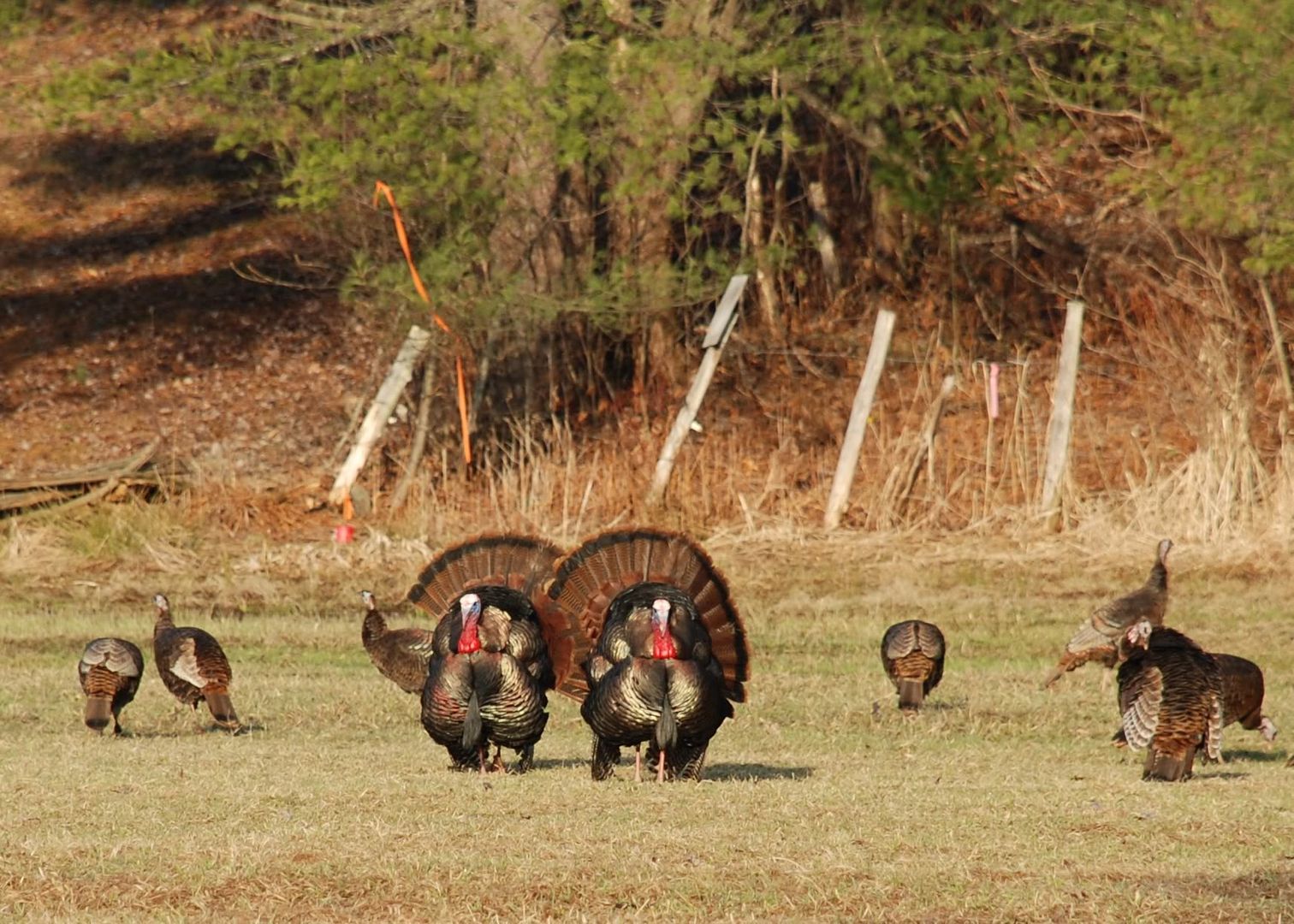
Driving to work yesterday morning, I saw a Tom Turkey parading toward a flock of Hens.

His chest feathers were puffed and his tail feathers were fully splayed and displayed. One look into his beady bird eyes and you could see the call of spring’s ritualistic Cock-on-Hen, “One Cock for one Flock,” why-don’t-we-do-it-in-the-road thoughts of old-school “traditional” Wild Turkey flying feather bird lust.

This guy was being controlled by primal urges known to virtually any organism residing even one evolutionary tick above an amoeba. The call of nature, in its most primitive form, was commanding his every action.

Didn’t want to miss this show! Grabbed camera and jumped out of my truck then quietly stood (perched!) on the side of the field just like any other puerile voyuer nature lover would do.

This guy was primed for action.

When he caught up to the Hens, the girls seemed shy at first.  They became friendly in pretty short order though.

I should tell you that the radio was on when I jumped from my truck. While shooting photos of the amorous Turkeys I was listening to a news report about the General Assembly’s passage of the marriage equality bill.

This is where things became, err, different. As the news report played on the radio, it was almost as if the Turkeys had heard the same story I did about Vermont giving legal recognition to the marriages of same-gender couples. As if on cue, two more Tom Turkeys, who were also mingling within the flock of hens, turned away from the ladies.

Next thing you know . . . .  (you need to click to believe) . . .


Damnedest thing I ever saw.

With no interest in the hens WHATSOEVER, the two Toms puffed themselves out – apparently for each other – and paraded off, together.

“One Cock for one Flock” and “Tom & Tom” seemed equally in harmony with nature.


—-

Someone asked me if the two Toms were photoshopped.  The two Toms are not altered. Here is the original photograph.  As Paul Harvey would said, Tom and Tom are the “rest of this story.”