Healthcare As a Human Right Campaign succeeds in getting Racine to take up single-payer in 2010

Hello Everyone:  

Health care reform in Vermont is still out there.  The Vermont Workers Center “health care as a human rigt campaign” got a promise last night from Racine at a public forum at St. Michael’s college to take up single-payer healthcare, specifically the two-single-payer bills now laying dormant under the dome, S.88 and H.100, in the next session. We could now be on our way to finally getting a rational and sane health care reform in Vermont, despite the insane stupidity of the Federal non-efforts.   Let’s hope so.  

The Worker’s Center has been holding these forums around the state.  The first one was in Montpelier in September; the next one is in Warren, on the 8th of this month, at the Warren Library, followed by the Lamoille County Forum on the 17th of December.  With luck Shap Smith will be there.  So far, we’ve had about 70 legislators from all over Vermont attend these forums.  If we can get more and make ourselves heard even louder, maybe we’ll get the reform Vermont so desperately needs this year.  The announcement of Racine’s intent follows.  

“Healthcare Is a Human Right campaign succeeds in getting single-payer healthcare taken up in 2010 in Vermont Legislature

COLCHESTER, VT – Tuesday evening at the Vermont Workers’ Center’s second Chittenden County People’s Forum on Healthcare held at St. Michael’s College, Senator Doug Racine, chair of the Senate’s health and welfare committee, announced that his committee will begin holding hearings on S.88, the bill that, with its House companion, H.100, will put Vermont on the road to enacting healthcare as a human right.

“Healthcare is the most basic of human rights,” said Racine, who has scheduled the first public hearing – to be held jointly with the House health care committee – for January 12, exactly one week after the start of the 2010 legislative session.

Racine’s choice of Tuesday’s Healthcare Is a Human Right forum for the announcement was seen by many as recognition of the success of the Vermont Workers’ Center’s state-wide, grass-roots campaign at putting pressure on the Vermont legislature to enact healthcare-reform legislation that embodies human-rights principles.

“We now have organizing committees state-wide and we have been working with a number of other organizations to build a grassroots network capable of changing what is politically possible for healthcare reform in Vermont. It is clear that these efforts are pushing things in the right direction.  We hope other Vermont elected officials will join Senator Racine as champions to make this moral shift to make healthcare a public good for everybody,” said James Haslam, Director of the Vermont Workers’ Center.  

Six other state legislators participated in the forum, which was the eighth of its kind the Workers’ Center has held this Fall with a total of 70 state legislators and over 800 total participants.  The event included testimony from area residents about their experiences with the broken healthcare system and a presentation on the principles and goals of the Healthcare Is A Human Right Campaign.  

On January 6, for the start of the 2010 legislative session, the Workers’ Center plans to solidify this position by delivering thousands of postcards demanding healthcare as a human right that Vermonters from around the State have signed to the legislative leadership.

“Vermont can lead the way.  Where Congress has failed to stand up to the corrupting influence of powerful interests vested in the unsustainable healthcare status quo, Vermont will succeed,” said Bekah Mandell, the facilitator of the People’s Forum and who is a leader of the Healthcare Is a Human Right Campaign. “Ordinary Vermonters will continue to put pressure on their elected representatives until we win this fundamental human right. It is clear to us, now, that we can win, and we will win.”

The next People’s Forum on Healthcare is scheduled for Lamoille County at 7 P.M. on December 17th at the River Arts Center in Morrisville, where House Speaker Shap Smith and other state legislators are expected to participate.”

Will Dubie be a do right man?

Will the Republican candidates here in Vermont get caught up in the purity of thought movement taking hold in the Republican right wing?

Nationally Republican leaders have been circulating a resolution listing 10 positions Republican candidates must support if they want RNC backing. To gain the seal of approval candidates have to show faithful adherence to conservative principles and public policies, demonstrate opposition to Obama’s socialist agenda of government-run health care and cap-and-trade along with opposition to easing union secret ballot rules, and finally support of military-recommended troop surges and the Defense of Marriage Act. It’s all Dick Armey approved. Armey, head of FreedomWorks and a lead TeaParty enthusiast, supports these loyalty tests.

Last week on Vermont Edition, Middlebury’s Eric Davis predicted that in the coming gubernatorial campaign Republican Brian Dubie would not have to deal with conservative Tea Party issues. Almost as if it couldn’t happen here because our Republicans are too nice, Davis said he had a sense that the Tea Party was much smaller here in Vermont than in other parts of the country. It may or may not be smaller than in other parts of the country but it is making itself heard. Newly declared Republican candidate for US Senate Len Britton decided to make one of his first stops hunting for support at an early northern Vermont screening of Tea Party: The Movie.

Britton, along with most of a Republican County Committee, were treated to a sneak preview of that inspirational film.  

Vermont View reporter’s blog notes that nationally the Vermont Tea Partiers are mentioned by Talking Points Memo as among those active enough to go to Washington with their counterparts to lobby Washington lawmakers.

Dubie’s campaign style (tactics?) of avoiding debates and relying almost exclusively on friendly audiences may require coming to terms with the Tea Party. Len Britton, with his feet on the ground, apparently knows this already. As for Davis’ prediction that Dubie won’t have to deal with the Tea Party elements of the Republican right in Vermont because they are smaller than elsewhere, one only has to think back to the nasty campaigns lead by Ruth Dwyer years ago. Looking at an old Inside Track column from 2005, I was reminded that one of Dwyer’s strong financial supporters was none other than Skip Vallee, Dubie’s potential rival for the Republican nod to run for governor.

Leahy critical of Obama on US continued refusal to sign landmine ban (Updated w/video)

This is a healthy thing. We need more debate, not less, on these issues. And Senator Leahy does not mince words:

But can anyone imagine the Unites States using landmines in Afghanistan, a country where more civilians have been killed or horribly injured from mines than any other in history?

A country which, like our coalition partners, is itself a party to the treaty?

[…] Can anyone imagine this President, who has been awarded the Nobel Peace Prize which only a few years ago was awarded to the International Campaign to Ban Landmines, having to publicly defend such a decision?

It’s also a smart thing. One wonders why Obama has wavered on signing onto the international treaty to ban land mines in the first place (presumably a political calculation), but given the heat he is only beginning to take from the left on military policy, he may well be open to reconsidering the political calculus. It has been his pattern to follow major disappointments to his base with some sort of policy compensation prize, and if Senator Leahy and others push on this, they may get traction.

Full comments after the flip.

STATEMENT OF SENATOR PATRICK LEAHY

On

THE CARTAGENA LANDMINE BAN TREATY REVIEW CONFERENCE

Senate Floor

December 1, 2009

MR. LEAHY.  I want to speak briefly on a subject that many Members of Congress – Democrats and Republicans – have had an abiding interest in over the years.

Throughout this week, delegates from countries around the world will gather in Cartagena, Colombia, to participate in the Second Review Conference of the Convention on the Prohibition of the Use, Stockpiling, Production and Transfer of Anti-Personnel Mines and on Their Destruction.

The Cartagena review conference, would have been the perfect opportunity for the Obama Administration to announce its intention to join the 156 other nations that are parties to the treaty, including our coalition allies in Iraq and Afghanistan.  

In fact, every member of NATO and every country in our hemisphere, except Cuba, is a party to the treaty.  The United States is one of only 37 countries that have not joined, along with Russia and China.

By announcing our intention to join the treaty in Cartagena, this Administration would have signaled to the rest of the world that the United States is finally showing the leadership that has been wanting on these indiscriminate weapons that maim and kill thousands of innocent people every year.

The United States military is the most powerful in the world.  Yet we have seen how civilian casualties in Afghanistan have become one of the most urgent and pressing concerns of our military commanders, where bombs that missed their targets and other mistakes have turned the populace against us.

Despite this, one of the arguments the Pentagon makes for resisting calls to join the Mine Ban Treaty is to preserve its option to use landmines in Afghanistan, even though we have not used these indiscriminate weapons since 1991.

Since the Pentagon has never voluntarily given up any weapon, including poison gas, which President Woodrow Wilson renounced in 1925, perhaps this is to be expected.

But can anyone imagine the Unites States using landmines in Afghanistan, a country where more civilians have been killed or horribly injured from mines than any other in history?

A country which, like our coalition partners, is itself a party to the treaty?

A country where if we used mines and civilians were killed or injured the public outcry in Afghanistan and around the world would be deafening?

Can anyone imagine this President, who has been awarded the Nobel Peace Prize which only a few years ago was awarded to the International Campaign to Ban Landmines, having to publicly defend such a decision?

I wonder if anyone at the Pentagon has thought of the military and political implications of that.

Last Tuesday, the State Department spokesman announced that the Administration had completed a review on its landmine policy and had decided to continue supporting the Bush Administration’s policy, which was, in key aspects, a retreat from the policy of President Clinton.

This was a surprise to me and others, as I had encouraged the Administration to conduct such a review and then heard nothing for months.  In fact, I had spoken personally with President Obama about it just a few weeks before.

I did not hesitate to express my disappointment, as did many others.  Shortly thereafter this wave of criticism, the State Department reversed itself, and announced that a “comprehensive review” is continuing and that it would send a team of observers to the Cartagena review conference this week.

It may well be that the State Department spokesman misspoke.  Whatever the truth is, the Administration’s approach to this issue up until this past weekend has been cursory, half-hearted, and deeply disappointing to those of us who expected a serious, thorough reexamination of this issue.

One would hope that an Administration that portrays itself as a global leader on issues of humanitarian law and arms control recognizes this is an opportunity.

Any serious review should begin by examining the extensive history of the negotiations that led to the treaty, and the technical issues that were debated and addressed.

It should involve consulting our allies, like Great Britain and Canada, whose militaries have operated in accordance with the treaty’s obligations for a decade, including with our forces in Iraq and Afghanistan, to determine what their experience has been.  

It should involve consulting with the Pentagon, of course, but also with retired senior U.S. military officers and diplomats, many of whom have expressed support for the treaty.

It should involve consulting with Members of Congress, and with the humanitarian and arms control communities who have extensive expertise on all aspects of the treaty and its implementation.

Unfortunately, none of these obvious steps was taken.  Instead, an opaque process involving limited consultations with the Pentagon simply resulted in a regurgitation of the Bush Administration’s talking points.

That is not what we expected from this Administration, and I welcome the announcement that a comprehensive review will be carried out.

The United States has not exported anti-personnel mines since 1992.

We have not produced anti-personnel mines since 1997.

And the United States has not used anti-personnel mines since 1991 – when many of them malfunctioned.

In effect, we have been in de facto compliance with the treaty for 18 years, with the exception of not yet destroying our stockpile of mines.

And in the interim we have invested millions of dollars to develop alternatives to indiscriminate landmines, to replace them with munitions that include man-in-the-loop technology, so they are not victim-activated.  

Indiscriminate landmines, whether they are persistent mines or those that are designed to self-destruct or deactivate, are nothing more than booby traps.  They cannot distinguish between an enemy combatant, a U.S. soldier, a young child, or a woman out collecting firewood.  They do not belong in the arsenal of any modern military.

I have supported President Obama and I look forward to supporting him on many issues in the future.  I hope this is can be one of those issues.

I am confident that if a proper review is conducted, and the President considers the equities, he will conclude, as our allies have, that the humanitarian benefits of banning anti-personnel landmines far exceed their limited military utility.  Ultimately, this is a decision President Obama will need to make himself, just as President Wilson did almost a century ago.

I want to commend the Government of Colombia, a country where landmines have taken and continue to take a terrible toll on civilians, for hosting the review conference.  Colombia joined the treaty years ago.

I also appreciate that the State Department has sent a team of observers to Cartagena.  I hope they use this opportunity not only to highlight the hundreds of millions of dollars the U.S. has provided for humanitarian demining and assistance for mine victims over the years, but also to learn from the delegations of countries that are parties to the treaty.

I want to pay tribute to the leadership of Canada, and my friend Lloyd Axworthy, who as Foreign Minister showed the extraordinary vision and leadership that culminated in the Mine Ban Treaty, and to the other nations that have joined since then.

The treaty has already exceeded the expectations of even its strongest advocates.  The number of mine casualties has decreased significantly.  The number of countries producing and exporting mines has plummeted.

And at the same time, none of the arguments of the treaty’s naysayers have come to pass.

The United States is the most powerful nation on earth.  We don’t need these indiscriminate weapons any more than our allies who have abandoned them.

We have not used landmines for many years.  We should be leading this effort, not sitting on the sidelines.

It is time for the United States to join the right side of history.

# # # # #

Fighting Like a Superpower

Superpowers have a great advantage when they impose war on another country:  They never have to surrender.

Superpowers have a great DISADVANTAGE when they impose war on another country:  They never have to surrender.

Whether it wins a war or loses a war, a superpower can keep fighting without ever surrendering, without ever stopping, without ever acknowledging that the purpose for fighting the war (assuming there was one) has long since ended or the objective is no longer obtainable or realistic.  “Winning” or “losing” are ultimately irrelevant to a warring superpower because it can keep fighting as long as it wants.

There is no greater threat to the security of a superpower than for its leaders to continue fighting in a conflict long after that superpower lost the war. To continue fighting long after any chance to achieve a strategic advantage is lost.  To continue fighting long after there is any justification for the destruction of another country and the destruction of our own resources

By all objective analysis, the United States lost its war on Afghanistan shortly after it began.  The political leadership at that time, such as it was, announced that it would fight a “war on terror” in Afghanistan to make the United States safe from another 9-11 type attack. It was a war to protect the United States – to make us safer.  Indeed, why else does a civilized country go to war but to protect itself from the threat of destruction at the hand of another country?  By the end of 2002, despite toppling the Taliban, which was a feeble and the most recent political entity to claim control of Afghanistan, the strategically naive Bush abandoned any objectively reasonable policy that could have led to a safer United States. The haphazard occupation squandered any opportunity to achieve something constructive from our violent presence in that country.

By those “measures” — by the US’s own stated objectives — we lost the war before President Obama took the oath of office.

No matter what we do in Afghanistan now, the enormity of our killing, our lost resources and the hatred we have engendered have made the U.S. less safe. We have nothing to gain by staying and only the waste of resources and pain and suffering to inflict on Afghanistan if we continue the occupation. The only mission that will make the U.S. more secure in 2009, is a rapid withdrawal and a much needed and overdue honest discussion of the failures committed in the name of U.S. security over the past eight years.

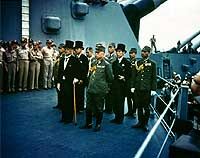
The continued failure to acknowledge that the “war” to make the U.S. safer was lost long ago, is ultimately an acceptance of that defeat. It compounds strategic losses caused by failed political leadership. The days of countries fighting until one could fight no longer are essentially over. We cannot expect that parties will meet at some point on the USS Missouri where officials recognize the end of a war.

Today, wars will end when men sitting behind desks, often many time zones away from the fighting, decide that there is no political strategic advantage to continuing the investment in bloodshed. We had no hope and no expectation of this type of (rudimentary) political strength or strategic vision from the last administration. Sadly, we have every reason to demand it from the current one.

The speech

I picked up my ten year old from shooting hoops at the rec center during President Obama’s speech on his “new” Afghanistan policy this evening. He gets in the car as Obama’s wrapping up his remarks. We drive the handful of blocks to the house, and as we’re getting out, my son (a big Obama fan) volunteers the following unsolicited opinion of what he just heard: “when Obama gets up and speaks about something, he always says the same stuff and acts like its the new thing.”

Indeed.

Listening to the President tonight was difficult. It’s hard not to look at the situation in Afghanistan as driving at top speed into a brick wall, simply because the people currently driving can’t see any alternatives. Listening to Obama, one gets the feeling on the one hand that he sincerely believes he is doing the right thing.

Then on the other hand, its even more frustrating to hear him make his point with what has become a typical rhetorical gimmick for him – mischaracterizing the views of those with whom he disagrees in order to sound more reasonable in comparison. Obama rejected any and all parallels being drawn between the wars in Afghanistan and Vietnam by alluding to points of distinction between the two conflicts that have nothing to do with the genuine points of comparison made by opponents of the war:

Unlike Vietnam, we are joined by a broad coalition of 43 nations that recognizes the legitimacy of our action. Unlike Vietnam, we are not facing a broad-based popular insurgency. And most importantly, unlike Vietnam, the American people were viciously attacked from Afghanistan

These points are hardly the points of comparison made by critics. It was akin to being told that any comparisons of the indistinguishable symptoms of viral pneumonia and bacterial pneumonia are invalid and irrelevant simply because one is viral and one is bacterial. Nitpicking at best, intentional obfuscation at worst. Annoying in either case.

On the other side, he placed himself in opposition to those on the right who reject any sort of firm date for a US withdrawal – except of course that the July 2011 timeframe to begin bringing troops home was anything but firm. In speaking to the media during the lead-up to the speech, Obama’s aides went to lengths to explain to reporters that this “deadline” was subject to change, and didn’t even indicate what – exactly – was supposed to start happening in July of ’11. We’ve been given a date that seems both arbitrary and meaningless.

Having said all this, to those that simply call Obama a “neo-con,” it seems clear that the vision and goals of the Obama administration in this arena are in fact distinct from Bush’s, at least in concept. In practice, however, we’re still heading towards the brick wall of a re-energized Taliban, fully united with partners across the Pakistani border, with a corrupt and illegitimate Afghani leader as our co-pilot.  

What makes it all the more discouraging is that there are scattered reports of some improvements on the ground (at least in some provinces) in recent months, but a further escalation stands to undo much of that progress.

I think the reaction from Rep. Welch is worth posting:

“Tonight, President Obama presented the right analysis of the situation in Afghanistan but reached the wrong conclusion.

“The President understands that we must vigorously protect Americans against another attack by al-Qaida. He recognizes the need for a regional, diplomatic effort that takes into consideration the strategic importance of Pakistan. And he understands that President Karzai’s failure to root out systemic corruption poses a grave challenge to the legitimacy of the Afghan government.

“Nevertheless, increasing our military footprint in Afghanistan will not achieve the goals the President outlined. Our goal, and our obligation, is to protect the American people from another al-Qaida attack. Al-Qaida is a dispersed group pursuing a radical and violent agenda.  It is not a nation state. Our strategy should focus on containing and degrading al-Qaida worldwide, not expanding our military footprint in Afghanistan, a country rife with corruption and a history of tribal loyalties rather than stable government institutions.

“The President’s policy is not financially sustainable. The cost of supporting one soldier for one year is $1 million – or $30 billion per year for the 30,000 new troops recommended tonight by the President. Our nation is crippled by record deficits and skyrocketing unemployment. We need to spend our scarce resources rebuilding America, not nation-building abroad.”

I don’t have the time to put into a serious analysis, but I encourage folks to check out this solid piece from Meteor Blades at Daily Kos:

After 60 days of comprehensive reviews and leaks about differences over those reviews within the administration, no surprises have emerged in the new strategy for the “good war” in Afghanistan that President Obama announced today. Not even the slightest hint about when the U.S. troop commitment might end. And not a word about the 550 or more prisoners in the infamous Bagram prison, many of them previously tortured and still held without recourse to legal or humanitarian intervention.

Good night.

Moo-doo Economics

Whenever I see Art Woolf’s name on the op-ed page, I brace myself for another truly incredible argument from beyond the looking glass. His letter in the Nov. 30 Messenger (cross-posted on Vermont Tiger) once again renders me near speechless.  He begins by observing that Vermont dairy farmers are “in a terrible pickle.” Ignoring completely the role that dairy conglomerates and retail giants like Walmart have played in creating this “pickle,” Woolf advances the following argument which barely alludes to the toll his beloved “free market capitalism” has taken on U.S. dairy farmers:

“Prices for their products are way down (in part due to the tremendous reduction in international demand for milk caused by the financial crisis and economic recession) and their costs keep going up. But it is disingenuous for Senator Sanders to suggest that despite being against allowing “guest” workers into the U.S., the predicament of the dairy industry in Vermont and elsewhere is so “desperate” that a guest worker program is needed to provide the farms with workers willing and able to do the manual labor jobs that farmers are unable to fill with local workers.”

He then goes on to state the obvious:

“Agricultural laborer jobs just don’t pay enough to attract Vermonters…”

and that

“If Vermont farmers had to pay a wage high enough to attract Vermonters, their economic plight would be even worse than it is today and even more farms would go out of business.”

That said, Woolf’s interest in the dairy farmers’ plight and any consequent threat to local food security seems to have been spent as he moves quickly to the real meat of his matter; namely, equating small local dairy farmers with financial institutions that benefitted from TARP!  

“The question is why Senator Sanders seems to understand this when it comes to farmers and their need for unskilled labor…So it’s OK for unskilled guest workers to work on Vermont farms to help them survive in a competitive market, but not OK for U.S. financial institutions to hire skilled guest workers to help them survive in a competitive market (?)”

This, from a member of the Economics Department at UVM, Vermont’s premier agricultural school, is a real mind-bender.  Apart from the obvious incongruity of equating small local food providers with greedy financial giants that have impoverished the nation while claiming huge personal bonuses, Mr. Woolf appears to be asserting a failure on the part of American economic academics such as himself to produce a pool of skilled domestic financial workers to serve at U.S. financial institutions.  If this is in fact the case, doesn’t that support one of Senator Sander’s other arguments that we should be committing more resources to raising the standard of living and education of American workers and their families rather than outsourcing jobs and opportunity to the lowest global bidders?

Earth to Professor Woolf:  Please do your homework.

Democratic gubernatorial primary: Looking at turnout and sketching some possible candidate goals

There are three “macro” ways to approach the challenges faced by candidates in winning the unprecedented Democratic gubernatorial primary we are already in the throes of, and those three can be rougly broken down as numbers, message, and strategies. We’ll look at all of these, of course (and revisit them ad nauseum), but let’s spend a minute breaking out the numbers.

As I said in this recent diary, there are a lot of factors that will drive up turnout – I believe that all together, they could bump us to unprecedented levels – perhaps even an overall primary turnout of 60,000 voters. That’s assumption 1. Assumption 2 is that this race is going to sugar out to three leaders rather than two (or four or five, for that matter), and as such, candidates should be aiming their sights on a magic number of 21,000 votes to wrap this up. A lot of assumptions, of course, but not completely random ones. Check here to see some of the reasoning.

So where are those votes going to come from, and – just as interestingly – where will these specific candidates find the votes they need? There are no perfect models to look to for the purpose of making predictions, but everyone reasonably starts off looking at the 2006 Lieutenant Governor primary between John Tracy and Matt Dunne that generated a lot of interest among self-identifying Dems. Here’s what the turnout in that race looked like:

Before going forward, I want to point out that for purposes of comparison, I have a serious fudge factor in play, as we’re looking at (more or less) current voter registration totals to compare the turnout against. I think this is a fudge factor of quality more than quantity, as the mismatched data for comparison sounds like a bad thing, but I don’t think voter registration totals (or population spread) have changed that much.

So the turnout curve comes very close to matching the population curve by county, which we’d expect. Looking at the primary turnout as a percentage of the overall population for a county, we see GOP strongholds such as Caledonia on the low end (5.06%), and Dem-heavier counties like Windham on the high end (10.29%). The mean county value of turnout as a percentage of registered voting population was 7.31% in 2006.

If we look at the 2006 and 2008 Democratic Lt Gov primaries, we see that having a “native son” in the race does consistently drive up turnout, but it’s hard to say how much, given that each County in question – Chittenden, Windham, Windsor and Washington – tend to be higher performing counties for Democrats anyway. On the low end, when looking at the previously mentioned mean county value of turnout as a percentage of the registered voting population, you see John Tracy’s Chittenden in 2006 over that mean by a mere 1.03%, compared to Dunne’s Windsor on the high end at an extra 4.5%. Now, Chittenden’s results were virtually spot on the statewide mean in 2008 when the candidates were Washington’s Nate Freeman and Windham’s Tom Costello, so one could reasonably conclude that this 1.03% represents the safe “bump” in primary turnout in a county with a local candidate running, but Tracy only represented one Burlington district (compared to State Senators and statewide officeholders). That, along with the uniquely varied demographics of Chittenden, leave me inclined to take the mean of the “local bumps” from Tracy and Dunne in 2006, and Costello and Freeman in 2008, and call that mean (2.7%) the real “local bump.”

What’s the point? To put together a rough-but-not-too-rough “turnout curve” based on a gubernatortial primary with candidates living in Washington, Chittenden, Windsor, Windham and Lamoille Counties, then inflate that curve by whatever percentage necessary to get the total turnout to 60,000, which I believe will be close to the actual Democratic primary turnout. Doing so will give us a sense of how many votes will be available to the candidates from each county, and may then give us a sense of what numbers the candidates need to generate from where in order to take the nomination.

Here, then, is one turnout projection for the 2010 Democratic gubernatorial primary by county. Please note that the campaigns will be working with far more precise projections based on town-by-town analyses. This is a very fuzzy, broad estimate based on statewide averages projected to the county level. No way do I have time in my life to do this right:

What follows are possible “victory spreads” for each candidate assuming the above turnout by county. I have to say, it was often challenging to generate profiles that felt realistic that added up to 21,000 in light of the many candidates and their many geographic areas of strength. CHittenden has most of the votes, but Racine is going to win in Chittenden. Windham is another Democratic vote-mine, that candidates other than Peter Shumlin can only hope to finish second in.

Let’s stipulate that nobody can win with less than a 15% turnout in any county. It’s also clear that each candidate may be able to emphasize different facets of traditional campaigning to get to these numbers (field, paid media, earned media, etc), but all these facets will have to be in play. We’ll look at such strategies, given the likely financial pictures faced by each candidate, in another diary.


Susan Bartlett: I’ll admit, it was most challenging to make these numbers work for Bartlett, primarily because Lamoille County is a relatively lightly populated base of support. Bartlett will need to take Lamoille outright and push that momentum into the adjacent rural counties. She could also package herself as an alternative to the other “interstate corridor” candidates in counties like Rutland and Bennington – but she’ll be hamstrung by low name recognition. Like everyone, she needs to make a good showing in Chittenden County, and perhaps she can use her geographic proximity to push towards a second place finish to Racine, especially if she works the suburbs.

To bring up numbers around the state, she’s going to have to work to counter the anytime-now official endorsement of Deb Markowitz by Emily’s List, which will give Markowitz a sort of anointed “woman” candidate status.

Matt Dunne: It’d be easy to say that Dunne just needs to repeat his 2006 performance and eke out only a few more votes, but it’s not going to work that way. Dunne did show, however, that one can lose fairly decisively in Chittenden County (where he only took one town against John Tracy) and still win the state.

Dunne will win the highly populous Windsor County, and could use his popularity and geography to take two out of three of the other southern counties, and come in a strong second to Shumlin in Windham.

Dunne has maintained a good field network, which will give him good numbers everywhere. If he can tap into that loyalty – particularly in counties like Orange with well-established Democratic networks that know him well – he can generate votes in every county. Again, a second place showing in Chittenden is necessary.

Deb Markowitz: Markowitz is popular across the state among Dems. She isn’t the favorite among many constituency groups (well, labor), but those groups have been hesitant to dive into primaries, and not been terribly effective when they do, so her popularity should stay strong. With her campaign office already staffed by Emily’s List folks, the actual endorsement is only a formality. Coming into this stage with a lot of money and the EL endorsement will give her an across the board spread among the primary voters.

Not only will she take Washington County, but will be in a strong position to make a strong showing in the other interstate corridor areas – particularly Chittenden and Windsor.

Doug Racine: There’s nothing like starting with a win in the most populous county, but it won’t be enough on its own, as such he’s going to need to work his unique strength among Dems in the more conservative burbs such as Essex and South Burlington to win Chittenden big.

Racine is likely to struggle in the northeast and have a harder time in the south, so he’ll need to maximize his vote in neighboring Addison as well as take a strong second in Washington. Emphasizing his business and Party connections could serve him well in conservative Franklin/Grand Isle, and may give him a pitch in the Springfield area and into Windham.

Peter Shumlin: Shumlin takes Windham and needs to take a strong second in Windsor. He also needs to translate some of this two county momentum into the other two southern counties.

Shumlin is well known and well liked among most primary voters, and will need to tap into that goodwill to compete in rural areas with strong Dem organizations like Orange, but will not do as well in Franklin, where he may be the only candidate to suffer in the conservative area from being identified with marriage equality. However, that same identification could help him mine votes in Chittenden and make a strong showing in Addison. Interestingly, he’s already been touting his appointment of Susan Bartlett to the Chair of the Appropriations Committee in campaign contexts, so that could translate to a second place finish in Lamoille for those who like Bartlett, but don’t see her as a winner.


The caveat to all of this? None of this will be easy, and looking at these possible victory profiles, I feel fairly certain that whoever wins will probably have a different spread when the dust settles. Still, as a beginning point of discussion, this is as good a place to start as any…

Campaign open thread (updated): Phil & Lenny in, Randy out.

From Totten: In the Lieutenant Governor race, Randy Brock is out, Phil Scott is probably in (confirmed by Hirschfeld this morning – Scott’s in).

Hmm… could Brock be keeping his Governor options open?

VPR reports that Pomfret businessman Len Britton ( who we mentioned as a rumored Republican challenger to Patrick Leahy back in early September, but we heard his name as “Lenny Britton”) is definitely in. We’re told he owns a lumberyard in Windsor County. Meanwhile, Leahy’s primary challenger (Daniel Freilich) will be holding a public forum at the University of Vermont today at 7 pm at the Dudley H. Davis Center (4th floor Livak Ballroom).

Also from VPR: Vermont Edition has started a series of interviews with the gubernatorial candidates. Matt Dunne was on this week. I haven’t listened yet – any reviews?

Calling it what it is …

bullshit.

Vermont’s own Ethan Allen Institute (named after a land speculator who made his money by reselling lands stolen by big government programs) is out and about pontificating about “school choice” and how much money it will save us.

In Conservative Ethan Allen Institute, in report, says school choice could save state millions (Barre/Montpelier Times Argus, 12/01/09) institute director Chris Robbins is reported as claiming “About $80 million could be saved by allowing school choice in Vermont, and as much as $300 million by increasing the number of students per teacher in the state”. (The quote is not of Robbins, but the article).

Let’s be real … this is just so much re-hashed bullshit intended to push a bullshit concept.

First off they’re talking about school BUILDING choice, not school choice. There is no discussion of doing away with layers of government mandates and the mandatory high costs that goes with these mandates (ever check out the price of standardized tests or books?).

The choice being offered by the institute named after a stolen lands speculator isn’t really choice for the students, but is instead a choice of who can grab the most cash.

Let me go through some of the claims as laid out in the article:

John McClaughry claims NOBODY will be turned down. There will be a school for everybody.

Well John, I have witnessed first hand how a private school will and did turn down a student with above normal physical needs. If it weren’t for the Williamstown public school system that young boy probably would never have known a classroom of his peers (the child died shortly after his 6th birthday). Perhaps we could have found something in St. Johnsbury as William Cruess, one time assistant headmaster and business manager at St. Johnsbury Academy suggested.

No problem … a 90 mile round trip ever day. That’s another great idea … MORE BUS TIME FOR THE RUG RATS!

Oh, and I forgot to mention … St J’s tuition is not “cheaper”:

Tuition for the 2009-2010 school year is $39,990 for boarding students and $13,470 for day students.  Fees for ESL Instruction are $4,210 for the school year and $5,600 for Summer ESL.  The Guided Studies program fee is $8,280 for the school year.

Nope … no savings there.

The aforementioned Robbins claims that charter or private schools can be run better and cheaper, and this may be true. The record for charter and other schools that don’t turn away the hard to teach is ambiguous at best, however. One cannot find a proper study that shows any advantage to such charter/private schools over the current publicly financed ones.

As to being run cheaper? That may be true, but that doesn’t equate to less expensive to the customer. Imaging your local school district having to increase your property tax to pay for return on investment not to mention additional company oversight in the form of executive salaries and bonuses.

Or imagine some school keeping the line on costs by taking that return on investment and additional salaries and bonuses out of existing programs! Teachers salaries? No problem … bust the union and drive ’em down … that will surely keep the well trained and experienced in Vermont.

Or maybe the free market for professional jobs doesn’t exist for teachers … just for school buildings.

Of course we could do away with foreign language or arts or other unnecessary riff raff to maintain return on investment that’ll keep the investments flowing in.

Oh, and don’t forget that local community investment in their local educational system. It sure will be a lot less expensive to pay off that school building while simultaneously tuitioning the town’s kids to another school.

The proposals put forth by the institute named after a speculator of stolen lands are nothing more than smoke screen for the forced funneling of your tax dollars into private corporations.

A child should not have to commute hours every day for their education. There are models that can be used to keep the educational system local and open to all.

School building choice and corporate ownership shouldn’t be on the table.

Good morning Vietnam

You remember that war, don’t you?

That was where the US (under a Democratic president named Johnson) decided we could jump ugly in somebody else’s civil war.

Vietnam had been stewing in conflict under the occupation of foreign (French in this case) troops for many years. When the French tired of the situation, the United States stepped in first at a low level measured in the thousands of advisers.

That simmering participation took huge leaps when war president Johnson upped the ante to hundreds of thousands of troops and lots of planes and artillery and war ships and stuff. And never forget the reality we directly participated in the slaughter of what many sources peg at millions of dead non-combatants. (I’m not even to start on the still ongoing environmental issues such as agent Orange … yet one more huge corporate interest well fed by the Democratic led war machine.)

In the end the war industry gorged themselves on our tax dollars, well meaning young people died and were maimed because they believed those they were taught to believe and the end only came when the Vietnamese people decided their own fates.

And now Obama has Afghanistan and his very own civil war to be in the middle of, and he’s in for a penny, in for a pound. This dog has Obama by the tail and isn’t gonna let go.

But this is what Obama wanted and wants. He spoke of this “good war” in Afghanistan often and prominently during his quest for the presidency, and he’s continued that line of talk since being elected.

I suspect most progressives just weren’t really paying attention.

Good morning Vietnam Afghanistan.