Tomorrow’s National Rally

Tomorrow, in every state capital and then some, protests in solidarity with the people of Wisconsin are being held. Teachers, nurses, firefighters, students, police officers and others  have occupied the Capitol building and streets of Madison, Wisconsin for a week and a half, and tomorrow is about firmly taking this effort national. The Vermont event is scheduled for noon at the Statehouse.

Organizers are casting this demonstration as a turning point, but I don’t believe in turning points. Advocacy, activism, change – that’s a process, rather than a static point, so hopefully tomorrow can mark a commitment to engage on these issues in a constructive way for the long haul.

But we’re going to have to look some realities in the eye to do that. Vermont is not immune from the forces in play in Wisconsin, and its not as simple as being “pro” or “anti” labor. Note that the Wisconsin state police union yanked down a website statement in support of the workers whose rights are threatened. This is a Governor they endorsed, and apparently to some in power in the police union, that coziness is more important than the fundamental right of their fellow citizens to collectively bargain. In this way, the Wisconsin labor community itself is not healthy, and can even be part of the problem, as a house divided against itself cannot stand.

We need to remember what the word “solidarity” means – all of us, from the day laborer up through the union leaders themselves. It means holding together as a movement, rather than a bunch of loosely affiliated individuals or individual organizations, and standing up for everyone’s right to collectively bargain, period.

Let’s hope tomorrow signals a re-commitment to that principle.

Looking Forward

A number of years ago I was going through a pile of my books and I discovered a copy of Edward Bellamy's Looking Forward.  Turns out I'd checked it out from the Colby library over a decade earlier and failed to return it, and somehow they never found out.  I figure that all the massive donations I gave the school during my Gravy Train Days have more than made up for the fines, and the reason fate allowed me to keep the book was so I could write a superfluous, Tom Friedman-esque opening graf for an inconsequential blog post (minus any cab drivers).

Anyway, what interested me in Bellamy's groundbreaking tome was his obsession with “the labor question” and its solution.  My cadre of 6 regular readers might recall one of my majors at Colby was Russian and Soviet Studies (I graduated the same year the Soviet Union gave up the ghost).  So labor and the proletariat thing was something I investigated as part of the curriculum, though I tended to focus more on the philosophical side of things (e.g., Marx's inversion of Hegelian Dialectic, etc) being a Philosophy major as well.

If I'd been a more motivated student, I would have been another person.  I also would have pursued a thesis–assuredly not unique, nor particularly accurate or insightful–about unions that I toyed with before wandering down the Wittgensteinian path of the philosophy of language (that's how I chose to mate my two fields of study).

I saw some hints of that thesis in an article I read today at Salon (yes, I still read Salon):

Lind correctly notes that American labor unions have historically resisted universal social programs in favor of their employer-based bargains. But this has much to do with the very same reasons that American labor unions have in the past been less successful in reducing economic inequality. American labor unions are characteristically fragmented and historically wedded to a narrow, craft-union philosophy. But labor unions are undergoing tremendous change, as they must if they are to survive. Accordingly, it is not clear why Lind holds up the Old Labor of the past as any indication of how a revitalized labor will act in the future. The labor movement must do more to change itself, but given the transformations thus far, there is little reason to think the New will be anything like the Old.

I recommend reading the original Michael Lind piece from earlier in the week–I found much to agree and disagree with, and appreciate the follow up article today.

Now lemme walk this back a few steps.  I studied the Soviet Union and Marxism because I wanted to understand our Cold War adversaries (I was originally attracted to the Russian language because of family history).  I thought Marx was pretty out to lunch, but had some decent observations and kinda just missed the point.

I wrote a not-entirely-bad paper (hey, it got a B+) about historical frames of reference that used sci-fi as an analogy, particularly relying on Forbidden Planet and Star Trek amongst other things to show how our imagination of what's possible can evolve: the latter illustrating the limits of 1950s thought with flying saucer ships and intoning that we don't get to the moon until the late 21st century (not to mention gender roles); the former, possibly ironically, still spoke of Leningrad just a few years before the USSR collapsed.  

Yeah, it was a strange piece of work, but the pop culture thing helped me understand how trapped we are by our contemporary context, and that Marx was writing in a particular epoch.  Bottom line was that Uncle Karl couldn't foresee the rise of the labor movement as we know it today, what an idiot, etc.

The way I looked at it, unions have not only served as agents of social and economic change, improving working conditions and whatnot, but really as a bulwark against revolution and socialism itself.  Sure they might have been revolutionary to some extent, and have some elements that smack of socialism, but they allowed us to achieve greater equality and better lives for most workers without wholesale rebellion.  Labor was able to gain more of a stake in the future, corporate governance and whatnot, change the dynamic of its relationship with capital, obviating the need for regime change and the proletariat taking over the means of production.

But it seems that all revolutions become institutionalized, ossified, and unable to continue progressing.  Any criticisms I've ever had about labor has been focused on union leadership which, while maybe a reflection of membership, is still as divorced sometimes from those it represents as our government is from the electorate.  One place where they've certainly appeared to be rather parochial and counterproductive is in the healthcare debate.

I am not going to fully document this and admit my recollection might be completely off-base here, so welcome any correction.  But the lasting impression I have going back to the beginning of the HCR debate is this: the AFL-CIO in particular came out in staunch support of single-payer, said they'd fight hard for a public option and would refuse to help Dems who didn't work for that, then capitulated on the diluted, wholly imperfect ACA once they got a concession on th Cadillac Healthplan Tax.  Even if that capsule history is too simplistic and not completely correct, the fact remains that a force that should've been able to mobilize for real reform ended up backing away from the fight.

That's not just a critique of any specific unions or labor in general.  It goes for all of us.  But I had higher expectations that even with dwindling numbers there was an opportunity for the unions to get more people in the streets and the halls of Congress.

I think the problem of 2009 and 2010 is perfectly illustrated by the great action we're now seeing in WI and other states.  The corporatists have done a great job on the divide and conquer routine.  I've seen so many comments online (which may or may not be representative of anything, but I'm a blogger, so whatever) that reflect this: if unions are so great, why aren't more people in them; why do the unions only protest when stuff impacts them; why didn't the public sector unions fight when we private sector folks were getting laid off; etc?

So we're siloed.  In a union or not?  Private sector or public?  Work at a company with good benefits or shitty/no benefits?  And we fight for our small piece of the pie instead of fighting to make sure everybody has a decent piece.

We need to defragment ourselves and defragment our social benefits.  And that's where unions come in, and eventually get rid of themselves.  Unions need to fight as they have been to hold the line against corporatist dilution of our rights and power.  And non-union people need to join in that struggle, as we've seen in Madison and elsewhere.

Then we finish the job and move away from reliance on employer benevolence.  We all fight united for single-payer so we might benefit from the political entity we incorporated to promote the general welfare, and unions will be no longer necessary–they kept us from succumbing to socialist revolution, and now they can provide a bridge to the next progressive stage before riding off into the sunset.

As Uncle Abe said in his State of the Union message to Congress in 1861

Labor is prior to and independent of capital. Capital is only the fruit of labor, and could never have existed if labor had not first existed. Labor is the superior of capital, and deserves much the higher consideration. Capital has its rights, which are as worthy of protection as any other rights. Nor is it denied that there is, and probably always will be, a relation between labor and capital producing mutual benefits. The error is in assuming that the whole labor of community exists within that relation. 

We need to stop operating with old assumptions about the relationship between capital and labor.  Capital may have lots of dollars and lackeys in government at the moment, but we have the numbers and are starting to show our collective will all around the country.  We have it in us to defend what so many people fought and died for, and to make additional gains if we keep the momentum.

I'm not sure if Bellamy would've been surprised that by 2000 (or 2011) we still weren't (or aren't) a workers' utopia.  He can be forgiven for not exactly predicting the future of labor (yet he was uncannily prescient about a lot of interesting technological and societal developments).  Even though most of the folks in WI, IN, OH and all over the US haven't read his book, they are helping realize an important component of Bellamy's vision: The enfranchisement of humanity…may be regarded as a species of second birth of the race.

Let's stay at it so we can look forward to a more humane future for ourselves and our posterity.

ntodd

PS–I know this is meandering and longwinded, and quite possibly not overly coherent.  Been a rough couple weeks with SamLTPax and I'm not sure I've got all my wits about me, but I felt compelled to blog this and it just kinda took on a life of its own.  So there you have it.

Now they’ve done it!

Oh nooooooo! Those who can most afford to pay a little more might get a tax hike!

Oh how the wealthy hate taxes,won’t they all leave?

What? What’s that? Oh, it’s barely even on the table yet?

Wow, with all that screaming I thought someone was in real pain…    

Thatcher Moats of the Vermont Press Bureau reports  

In an effort to ease the impact of proposed budget cuts on vulnerable residents, a group of Progressive and Democratic lawmakers announced a plan Thursday to increase taxes on the wealthiest Vermonters.

Offered as an alternative to continued cuts in critical state services Rep. Chris Pearson, Rep. Susan Davis, Sen. Dick McCormack and Sen. Anthony Pollina as part of a broader plan have proposed a tax hike on those earning more than $171,000.

Under the plan, the top income tax rate would increase from 8.95 percent to 10.45 percent and the second highest tax bracket would increase from 8.8 percent to 9.8 percent, said Pearson.


Before the anguished screams get too loud please note what Sen. Dick MCormick points out about this plan

not a scheme to “eat the rich,” but a method for going where the money is.  

“The people who will pay this if this passes will be rich after they’ve paid their taxes,”


Our newest banana republic

They used to use the term “banana republic” to refer to countries in Central America in which the government was run as a tool for the oligarchies that became rich by exploiting the natural resources of the country.

Now we have the official transformation of a state with a proud Progressive tradition into a banana republic.

Josh is reporting that after the Wisconsin Assembly concluded debate on Walker’s anti-union bill, they went immediately to a vote. The vote lasted seconds, and as soon as there were enough Republican votes to pass it the Republican Speaker closed the voting.

The majority of the Democratic caucus didn’t even get to have their votes recorded, even though they were pounding furiously on their electronic voting buttons.

The Democratic members of the Senate are standing firm, and there are suggestions that the vote was illegal and may be subject to a court challenge, but Wisconsin has taken one more step toward being a wholly-owned subsidiary of Koch Industries.

The Last Choice

Here’s the question: When I am – or you are – terminally ill, who should decide when to call it quits? Right now, it’s mostly hospitals and doctors, with enforcement from the state.  

I don’t want hospitals, churches, or the government making decisions for me about what happens to me at the end of my life. If I’m ill with a terminal disease, then the last choice I get to make should be how I leave this world.

Oregon has led the way in providing terminally ill patients with medically supervised options.

Next week, George Eighmy will be in Vermont to talk about how the more than 10 years of patient choice in dying law has worked out there.

For 12 years he was Executive Director of Compassion & Choices of Oregon, providing non-judgmental information on end-of-life options; he retired last fall.


Vermont’s Patient Choices at End of Life invites all who’d like to hear about Oregon’s experience with Death with Dignity to join them at an event with George. Bring your questions and your friends and family. Copies of Vermont’s proposed Death with Dignity bill (H.274) will be available. All events are free and open to the public.

The first public discussion is Wednesday, March 2nd from 6:30 – 8 pm at the St. Albans Historical Museum, 9 Church St. 3rd fl (enter through rear of bldg. – elevator available).

The rest of the schedule is below:


Thursday, March 3rd

12:30 pm – 2 pm

Middlebury Town Hall Theatre

68 South Pleasant (Merchant’s Row – on the Green)


6:30 pm – 8 pm

Mark Skinner Library in Manchester Center

48 West Rd, just off 7A


Friday, March 4th

6:30 pm – 8 pm

Hardwick Memorial Building, 3rd Fl., 20 Church St.

elevator available at Police Dept entrance. Others enter through main door and go up the stairs.


On the Radio:


MARK JOHNSON SHOW

WDEV

Thursday, March 3rd

9:00 am – 11 am (not sure what time George will be on)


If you want to read the bill or a detailed outline of H.274, you can find both here.

I have seen how hospitals dealt with both of my parents and my mother-in-law and father-in-law: invaded by tubes, pumps, ventilators, beeping monitors, their eyes asking for release whenever they were awake. They all had Do Not Resuscitate (DNR) orders in their charts. It made no difference.

My father-in-law’s only option for controlling the end of his life was to starve and eventually dehydrate himself to death.

At the end of their lives, both my mother and my mother-in-law found themselves in hospitals with the whole array of medical and mechanical interventions preventing them from dying long after they said they were ready. My 61-year-old mother declared she was ready to die after her third or fourth round of ineffective chemo. The hospital instituted an intrusive ‘suicide watch,’ further destroying any possibility of choice or dignity at the close of her life.

Over a decade ago the woman who was a second mother to me chose to die at home. On a day when she could swallow, she asked for help to consume an overdose of pain medication. One (non-medical) person accepted the legal risk of holding a glass of water and opening the prescription container for her. Everyone close to this woman heaved a sigh of relief when the family doctor later certified the death without question.

Why is it that hospitals get to decide how they can wring out the last dollar from a dying patient regardless of the pain and intrusion they cause or the lack of expected positive result? Why is it that the patient cannot decide how they wish to die, and get expert advice and care from a medical professional on how to accomplish that final request?

The Death with Dignity bill (H.274) being considered in the legislature has so many safeguards against misuse that it may well encourage a dying patient to give up on the process: as currently drafted the bill requires that the patient must be terminal (six months or less to live), request a life-ending medication verbally on two separate occasions, and make a third request in writing before two non-family, non-caregiver witnesses, and all of this AFTER getting a second medical opinion and discussing comfort care and hospice care and pain control. There’s also a two-week delay built into the process.

Oregon’s 10 years of experience with patient choices in dying show that for some patients, just knowing they have the choice and control the means of their dying is enough, and they never actually use it.

Death with Dignity provides an option, not a requirement. It’s the last choice you’ll get to make – if the bill passes. If you want more control over the last days of your life – you should tell your Representatives and Senators you support this bill, and they should, too.

At least go hear George Eighmy. He’s lived with the process for 10 years.

More on Howard Shaffer’s Vision of Nuclear Evangelicism

As I mentioned below, the point man in the Ethan Allen Institute’s UVM-sponsored, right-wing ambush of Arnie Gundersen during tonight’s VT Yankee “debate” is Howard Shaffer. Shaffer is a prominent member of Lynchburg’s Christian Nuclear Fellowship, which includes in its “about” page this purpose:

Believing that Christ is Lord of every aspect of our lives, our purpose is to encourage each other to live out our Christian faith day-by-day and to apply Christian principles, Christian ethics, and a Christian worldview in all aspects of our personal and professional lives.

And yet, as Caoimhin Laochdha detailed in the comments below:

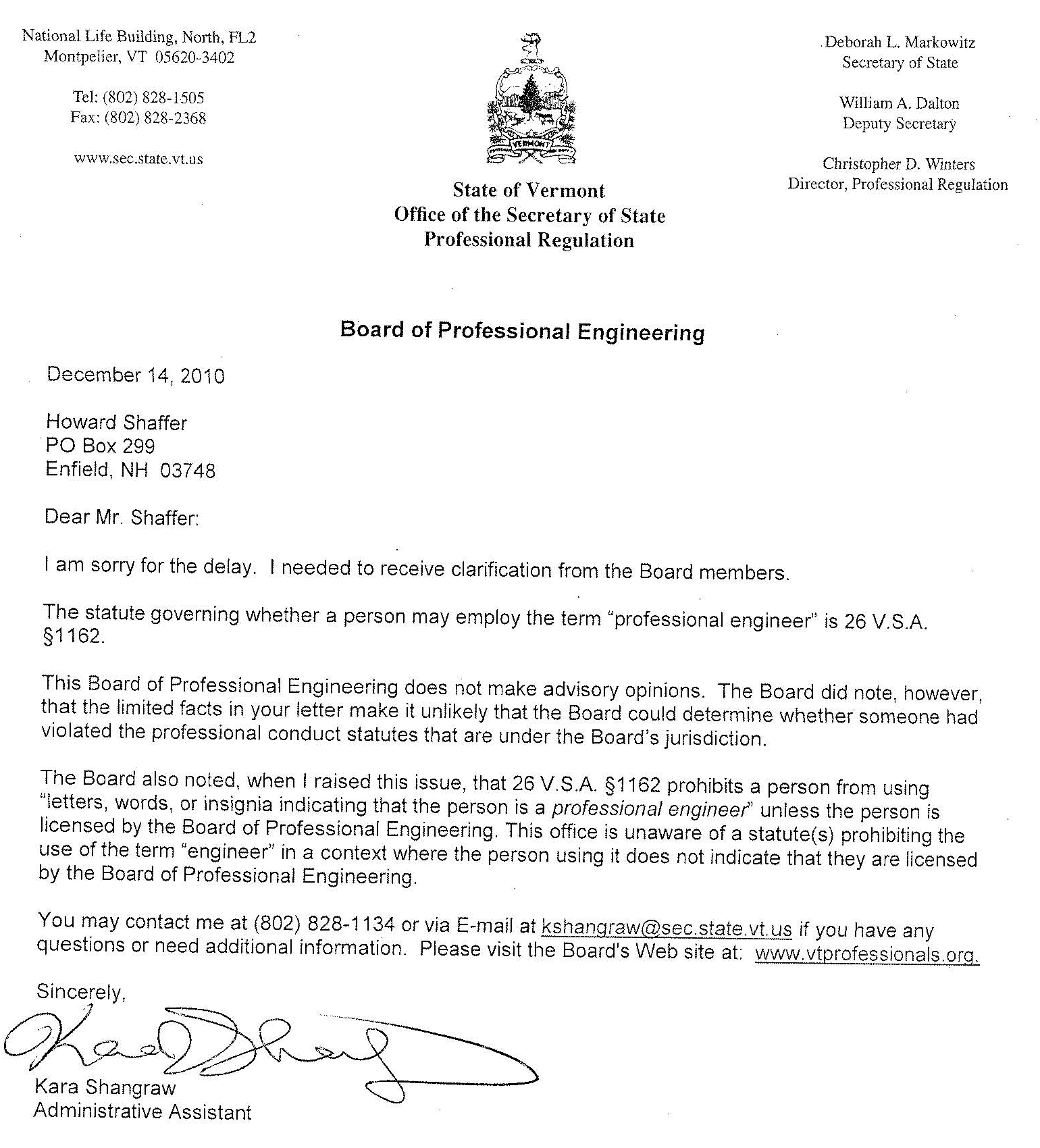
“Mr. Shaffer, ignorant of regulatory policy, attempted to stifle Mr. Gundersen as well as run his legal bills by complaining to a State regulatory body. That agency, the Board of Professional Engineering, possess quasi-judicial disciplinary authority. This included the power to levy State fines (in the thousands of dollars) and the Board of Professional Engineering also has statutory authority to seek injuctive relief in civil court and/or refer people for criminal prosection. Mr. Shaffer’s intent was a not-so-thinly-veiled attempt to use a State Agency to smear Mr. Gundersen’s reputation through mere allegations of wrong-doing.

Mr. Shaffer did not realize, however, that this particular State agency has NO statutory (i.e. enabling Act) jurisdiction over Mr. Gundersen. It has zero statutory authority over non-licensees who do not run afoul of the agency’s Title 26 enabling Act. The Board neither gave Mr. Shaffer a hearing or bothered to investigate Mr. Gundersen. The Agency did not even ask Mr. Gundersen to answer Mr. Shaffer’s allegations nor did it even bother to call Mr. Gundersen to ask for “his side to the story.” Instead it had a staff person send Mr. Shaffer a “pound sand” letter, and the Agency pointed out to Mr. Shaffer that, even without an investigation, Mr. Shaffer’s mean-spirited allegations raise no legal issue for State consideration. “

WWJD, indeed? Click here to view the official response to Shaffer’s Christ-like attempt to harass/intimidate Gundersen out of the same public arena he now gets his taxpayer-funder opportunity to ambush him in.

Updated: Anatomy of a Right-Wing Ambush – and taxpayer-funded, to boot!

(Re-bumped to the top for updates – promoted by odum)

Update #2 (from odum): I’m delighted to report an “I was wrong,” in that it sounds as though the debate was – as they say – fair and balanced. Couldn’t be happier that it ended up being a fair fight after all, regardless of how it was set up and promoted.


Updated by Sue Prent:

Well! That  was interesting. At almost the last minute, Meredith Anguin took Howard Shaffer’s place in the debate, as Mr. Shaffer was indisposed.

I had a parking challenge and arrived, a little late, just as Ms. Anguin took the mike to deliver her opening remarks. She focussed rather narrowly on the tritium leaks, attempting to persuade the audience that tritium is simply not such a big deal. Then she dismissed the collapsing tower as not central to operation of the plant, breezed over other condition issues and devoted most of her time and energy to arguing that closing VY would represent an economic calamity for businesses in Vermont

No doubt her views are sincerely held, but she failed to address the over-arching issues of mismanagement, negligence, lying  and simple obsolescence. Later, she seemed to imply that she thought the solution to all the issues might be a simple matter of new management(!?) She was of course at a disadvantage, since Howard Shaffer presumably prepared her slide presentation and notes, but all in all it was a pretty superficial stream of argument with a lot of attention devoted to the banana and “Exit” sign analogies in order to minimize the significance of tritium leaching into drinking water.

Arnie Gundersen, on the other hand came fully prepared.  Launching a well-planned slide presentation, he began by saying that the purpose of the forum was not to argue the pros and cons of nuclear energy, but rather to discuss why VY should or should not specifically be shut-down.  He then proceeded to explain, in a relaxed and articulate manner, all of the technical issues, managerial issues and some of the ethical issues that have lead him to believe that VY must not be allowed to operate beyond it’s planned expiry. Arguing that closure of VY will have much less  of an economic impact than is projected by VY supporters, Mr. Gundersen described the manner in which pricing and supply works on the New England Grid, and said that hundreds of jobs will be created after VY closes; first, to keep the plant safe and secure while it awaits decommissioning, and later to carry out the actual dismantling and disposal operations.

Each speaker was allowed a brief rebuttal, during which Mr. Gundersen defused the “Exit” sign analolgy with a little science, and reminded the audience that tritium was just the fastest moving (and therefore most quickly identified) substance leached from the broken pipes.  He pointed out that additional radioactive substances of much more deadly portent, were released at the same time but hadn’t yet travelled as far as the “plume” of tritium, which has already entered the Connecticut River.

Ms. Anguin’s rebuttal retrenched her economic arguments, and then, oddly enough, became focussed on Mr. Gundersen’s use of quotes from regional newspapers.  These were provided in his slide presentation to chronicle the growing public distrust that has accompanied VY and Entergy’s persistent misrepresentations, but Ms. Anguin seemed to find them really annoying.  When the rebuttal segment concluded,  Mr. Lynn opened the floor to audience questions.  Only one (from John McClaughry, of course)  was really angry and hostile to Mr. Gundersen, but that was quickly snuffed-out with a cool-headed response.   I think it was in reply to a question from an audience member that Mr. Gundersen said that it now does not appear that closing VY will in any way threaten the reliability of energy in New England.  This news seemed to take many by surprise, including an uncharacteristically subdued Emerson Lynn, who looked positively crest-fallen. The big economic boo-hoo they were depending on just didn’t deliver.

There was a sense in the end that the wind had unexpectedly left the sails of the VY Tiger team.  Nicely done, Mr. Gundersen!

_____________________________________________________________

It says something that conservatives so often feel they can’t win an argument unless they can fix the game. Get a load of this:

On Thursday, Feb. 24, hear two experts on nuclear energy debate the issue in the next installment of UVM’s Janus Forum: “Vermont Yankee: Shut It Down or Keep It Running?”

[…] Speaking in support of Vermont Yankee is Howard Shaffer, who has been a member of the American Nuclear Society (ANS) for 34 years.

[…] His opponent in the debate is Arnold Gundersen, chief engineer of Fairewinds Associates, the firm responsible for analyzing the shortfall in Vermont Yankee’s decommissioning fund, which resulted in a review of such funds at nuclear sites around the country.

Sounds interesting, yes? It is a slightly odd combination. As anyone who follows the issue knows, Gundersen is an obvious choice for the anti-VY side. Shaffer (of the “Christian Nuclear Fellowship” – no kidding), on the other hand, is a peculiar one under the circumstances, as Shaffer wrote to the Vermont Board of Professional Engineering and tried to have them demand that Gundersen could not call himself an engineer, because he was not a “Registered Professional Engineer.”

But that’s the tip of the iceberg. Dig this:

The is the sixth installment of the Janus Forum, a debate series founded by James Gatti, a finance professor in UVM’s School of Business Administration; Arthur Woolf, an economics professor in the College of Arts and Sciences; and Richard Vanden Bergh, also of the School of Business Administration.

Yeah, that would be Art Woolf, the patron saint of Vermont’s laissez-faire right wing and the poster boy for the hard-right Vermont Tiger blog. And Gatti? He’s only the Chair of the Ethan Allen Institute, John McLaughrey‘s baby Heritage Foundation for Vermonters.

Think that’s incidental, then why did Shaffer appear on WCAX promoting this event with Meredith Angwin, the pro-VY blogger who is running the Ethan Allen Institute’s VY-promotional Energy Education Project?

But wait, there’s more…

The forum will be moderated by Emerson Lynn, editor and publisher of the St. Albans Messenger.

Yes, that would be Emerson Lynn, Vermont’s leading media right-wing ideologue. Also a favorite of Vermont Tiger. Now, who are we missing… let’s see… oh, yeah! The Gundersens received a last-minute call from UVM Associate Communications Director Jeff Wakefield inviting Arnie to promote the event on a local radio show! Mark Johnson? Nah. VPR? Wrong again… it was… wait for it…

Rob Roper’s new show – yep, the former GOP Chair, True North Radio Host, and Vermont Tea Party favorite. Did you know he had a new radio show? Well, by jinkies he does! WDEV’s “Common Sense” radio show, sponsored by… The Ethan Allen Institute! What a coincidence!

See, the Ethan Allen Institute is not in favor of government sponsorship of…well… anything, really. Except that they seem to have no problem setting up a phony event to promote their agenda and ambush one of their favorite targets through the University of Vermont’s publicly funded platform.

Arnie will handle himself fine. Not only is he right on the issues, he’s smarter than the combined entirety of the sewing circle aligned against him. But this is still pretty gross, all in all. If the conservative pantheon wants to hold a “debate” on their terms, moderated by their person, promoted to their people through their media, and invite one of their favorite targets, just do it openly – through the EAI proper, with full disclosure – rather than engage in this weird, sneaky stuff.
Cheering the Home Team

…And in the spirit of crediting our elected officials when they get it right, I just want to briefly mention how proud we should be that our “DC three” (Leahy, Sanders and Welch) is the only state delegation that has received a perfect score from the League of Conservation Voters for their voting record on environmental issues in 2010!

In these days of economic anxiety and hair-trigger paranoia, it takes courage to stand-up for that singularly important but non-voting constituent: the natural environment.  It may sometimes seem like a thankless job, gentlemen; but we and our fellow life-forms salute you!  May your vision always be greater than the sum of your days on Capitol Hill.

The Poor Sufferin’ Rich

my three yachts

my wine collection

and the art works I have

prodigiously displayed

among my five homes

all my cars

and the Lear jet

do you think for a moment

I would allow such culture

and taste to fall into the hands

of the common rabble

not fit to wipe their snot

on my dog’s silk pawsocks?

get me the President, Charles

this nonsense must stop

imagine the gall of these people

behaving like Arab swine

no manners or breeding

yes, Mr. President

you really must do something

what’s that?

no, that’s not enough

bloody streets and busted heads

remember Chicago in ’68

we must make sure they get it

and also others watching

yes, it will look good

when it is spun right

people will think

you have a spine

all right then

I have guests tonight

we’ll watch it on TV

remember the dead

do not matter

remember what matters

my God, Charles

that man is thick sometimes

makes me yearn for Clinton

has Coolidge been fed?

did you get him the fetuses

from Lawrence Livermore?

and make me another martini

and dry this time, Charles

God, I have to do everything

Peter Buknatski

Montpelier, Vt.