Philip Hoff: How Red Turned Blue in the Green Mountain State by Samuel B. Hand, Anthony Marro, Ste


We may not know a giant among us. I certainly didn’t know it when I moved to Vermont just twenty years after Phil Hoff took office as the first Democratic governor in over a century, and I still didn’t realize it in the mid-1980’s when I was lobbying and he was in the Senate Judiciary Committee, but now, at a remove of half a century, there can be no mistaking the fact that Hoff was a giant of Vermont politics, the most important figure in the second half of the twentieth century.

When Phil Hoff took office Vermont’s governorship was a sleepy, caretaker institution, Vermont was the most reliable of Republican states, and the town of Averill, 2000 population 8, had the same one representative in the House of Representatives as Burlington, 2000 population 39,000. By the time he left we had had legislative reapportionment (in response to a mandate from the Supreme Court), Vermont had a modern executive and administration, and the state had irreversibly learned that government can facilitate and advance progressive change.

As the authors note, “No individual deserves more credit (or in the view of political rivals more blame) for the transformation of Vermont than Philip Hoff.” Those of us who did not grow up in Vermont can scarcely imagine the changes since his time. I think back to life in northern New Jersey fifty years ago and, while things have changed dramatically, the people, places, and institutions of that time are all recognizable today.

The opposite is true of Vermont.  

In Philip Hoff, the authors, a history professor and two veteran journalists, vividly portray the Vermont of the 1950’s and 60’s, illustrating the political life a young, energetic, politically ambitious lawyer found when he arrived, his early life among the “Young Turks” (mostly Republicans) in the Legislature, and the campaign and interpersonal strategies that brought him to the governor’s mansion in 1962. (Okay, the truth is we don’t have a governor’s mansion, but you get the idea.)

Once in office, learning that his tax department couldn’t give him a ten-, five-, or even a one-year projection of tax revenues, Hoff took the bold step of asking the legislature to essentially do nothing for the first year of his administration to give him a chance to understand the structure and the problems facing him and come up with a plan to make things work. A less gifted politician could never have pulled it off, but that first year of temporizing and planning was what set him on course to his later successes, accomplished without ever having a Democratic legislative majority to work with.

Phil Hoff really was to Vermont what people think JFK was for the country. The authors of this short biography put his life in perspective and, with their journalistic approach, bring the events to life. Although they clearly admire him they never descend to hagiography, and provide a balanced treatment of his failings as well as his successes.

Philip Hoff: How Red Turned Blue in the Green Mountain State is essential reading for anyone interested in how Vermont politics evolved from the conservatism of the 1950’s to the dynamism of the present.

Our favorite fish strikes again

This diary was prompted by reader bmike’s posting entitled “Salmon, dodging political crossfire?” Credit where credit’s due.

Man, I wish I was State Auditor of Accounts. Good pay, state bennies, and apparently not much to do. Because Tom Salmon CPA* must be really bored. He keeps coming up with stuff that has nothing to do with his job description. Which, according to state law, involves auditing state agencies and departments and funds held by the state or its officers. Regarding local government, the Auditor can audit entities that receive state funds. The office has no general authority to look into a city or town’s finances.

*That’s how he referred to himself in a recent press release. Has he legally changed his last name to “CPA”?

Still, he decided to send a 109-item checklist/questionnaire on local financial practices to the city of Burlington. And then he made a big stink when the city didn’t return it in by his self-imposed deadline. He’s also upset that Burlington hasn’t welcomed his offer to provide professional support.

That purported reluctance is rather understandable on Burlington’s part, given that Salmon has made himself a highly partisan Republican figure, frequently injecting himself into political issues, and having criticized Burlington’s financial management in the past. Welcome, fox, to my henhouse.

The brouhaha is written up in Vermont Digger. (The story is worth reading, and below it is a perceptive comment by Doug Hoffer.) By VTDigger’s account, Salmon sent the checklist to Burlington on January 3, requesting a reply by January 31. The city’s response was dated January 27, but “Salmon told VTDigger that he didn’t see it until about a week later.” By which time he had complained to a state House committee (on February 2, a mere three days “late” by Salmon’s standard) about Burlington’s failure to respond. And had issued a press release about his testimony, presumably seeking maximum exposure for his plaint.

January 27 to February 2. The Burlington-Montpelier mail run is usually faster than that, but never mind.  

After the jump: a possibly irrelevant checklist, a rationalization considered and rejected, and a revelation of piscine impotence.  

In a letter accompanying the city’s completed checklist, acting Chief Administrative Officer Scott Schrader defended the city’s financial practices and noted that the checklist “was intended to assist small Vermont municipalities” that might be lacking in basic accounting knowhow, and that no other Vermont community “undergoes a more rigorous and detailed review of its finances.”

According to Vermont Digger, the checklist was headlined as the “City Version” of the document, but that the only apparent difference between City and Town versions was a single question, “Has there been a theft or embezzlement in the last 10 years?” (The answer was “no,” by the way.)

If Salmon was serious about probing Burlington’s financial and auditing practices, you’d think he could have spent a little more time crafting a City Version.

Looking at this situation objectively, without regard to the personality or track record of our current State Auditor, one can see situations where the Auditor’s intervention into a local government’s affairs might be desirable, even if it’s tangential to the job description. If you’ve got a rotten town council who won’t take its citizens’ complaints seriously or is clearly squandering public resources, then somebody has to step in. And maybe the Auditor can be that somebody in certain situations.

But Tom Salmon has a track record of sticking his nose where it doesn’t belong, of making strong partisan attacks on Democratic officials and their policies, and of letting his attention drift from his core responsibilities like a dog distracted by a passing squirrel. In that context, his persistent prodding of Burlington looks less like the selfless act of a Good Samaritan CPA, and more like another move by an occasionally reckless attack dog. Er, attack fish.

Oh, two more things. First, there was a brief item about this on February 2 in vtBuzz, the Burlington Free Press’ politics blog. It included the line: “Salmon has asked legislators the authority to require municipalities to respond to his office’s requests.” (sic)

Wait. You mean that municipalities aren’t required to respond to your requests? Well, then, you really don’t have a complaint, do you?

And second, the best line in the Vermont Digger story:

“We passed on auditing Burlington Telecom because we didn’t want to be in a political crossfire,” Salmon told VTDigger. “We have a long history of patiently standing by.”

The sound you hear is the faint echo of laughter down the Winooski Valley and up the heights of the Green Mountains.

That’s a whole lot of heron

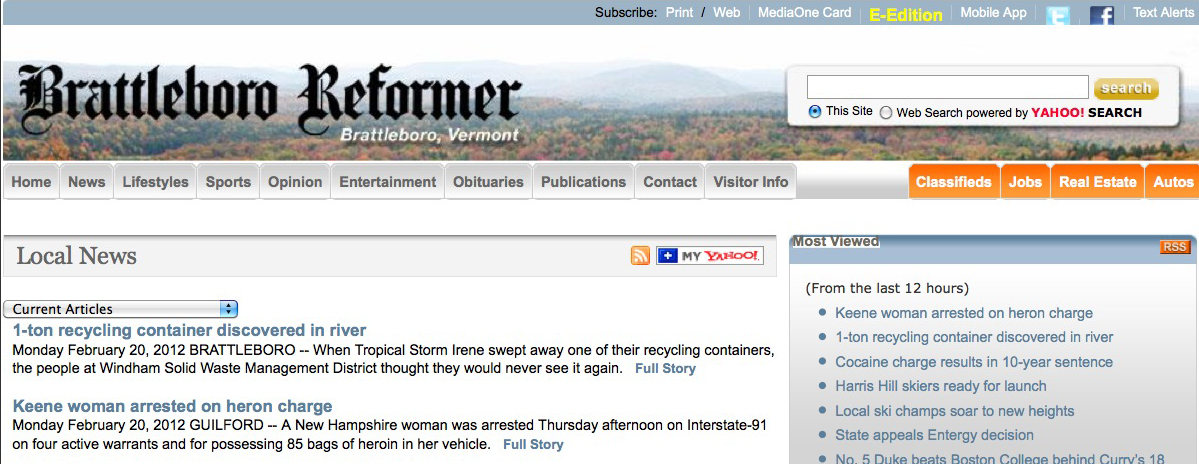
This is strictly for comic relief.  Today’s Brattleboro Reformer included a headline about a woman being charged for possession of Heron.  

As one commenter noted elsewhere, if she’s guilty of the crime, she egrets it now.

Just a reminder to all the editors out there: spell check will not always save you.

Sadly, the error was fixed fairly quickly.  It’s almost as though they don’t even want us mocking them.

Spoilsports.

Salmon, dodging political crossfire?

I had a good chuckle with our man of the numbers, Mr. Salmon:

“We passed on auditing BT because we didn’t want to be in a political crossfire,” Salmon told VTDigger. “We have a long history of patiently standing by. But they [city officials] don’t understand that they are not exempt.”

Sure wish he could use that judgement of not wanting to be in the ‘political crossfire’ when it comes to VY and other such policies…

Full read on Burlington getting a smackdown by the state auditor over on the Digger:

http://vtdigger.org/2012/02/19…

Mr. Hoffer has responded to the article, and perhaps JV or Doug will post something far more intelligent than I can about what the State auditor is trying to do by getting into the muck of local politics here in BTV.

The Hartford PD’s Full Press Facebooking

Vermont’s Hartford Police Department has had a fair share of troubles recently. Three times in a little more than one year cases alleging excessive force were deemed serious enough to be investigated by the state attorney general’s office. The department was cleared in all three cases but the AG did suggest changing officer training procedures. At least two news organizations and the Vermont ACLU have sued the Hartford Department for release of records in these cases.

Now in another case it appears the Hartford Police are being proactive in leveraging social media to defend their desire not to make records public after repeated requests from the press. The Valley News reports:

Hartford Police Chief Glenn Cutting denied the request, citing an exemption for records related to criminal investigations. The Valley News and other open government advocates in Vermont have argued that most records should be released once an investigation is closed, and [Valley News reporter] Davis then appealed to Hartford Town Manager Hunter Rieseberg.  

The case in question is a family murder and suicide. The sad incident was a murder-suicide committed by a 50-year-old man who killed his elderly mother and step-father, then committed suicide. Although family members have not seen the police records, they are citing worry about tabloid style sensationalism and would prefer the records stayed closed. They praise the department and are supporting the Police Facebook effort to stop the newspaper from pursuing release of the records in court. Over 50 family and friends have left comments on Facebook expressing similar support.

The Valley News editor Jeff Good expresses sympathy for the family, however, he says, “…but we also choose to pursue the information from the police investigation that the law says is public”.

Saint Michael’s College media studies department chairman David Mindich explains:

The Upper Valley readers who were siding with the police department on Facebook weren't distinguishing between the newspaper’s request for information and what it might ultimately publish.

The public has to be very careful not to side with police and government officials to censor the press or to thwart the press' right and, in fact, responsibility, to gather information,” he said.

“We care about families' feelings, but we also have to care about the health of our society, and how do you balance those two things? It's very difficult,”

Allen Gilbert, the head of Vermont ACLU, is alarmed by the police-sponsored Facebook page in light of the department’s past record.

This is the first time I've seen a public agency using social media not just to get around the press, but to intimidate the press. That's really how I see this. They are essentially trying to make you folks respond to public pressure in a way I don't see as justified,”


CNN Exposes Vermont Yankee and Entergy

I think this deserves high visibility here on GMD.

It pretty much speaks for itself, but can be supplemented with the many pieces we have featured here over the past years.

It has been my privilege to share with our readers the excellent analysis provided in a series of videos that can be viewed on  Fairewinds Associates website.

Arnie Gundersen of Fairewinds is featured in the CNN report.

The conscience of a salesman

This diary arose from my reading another GMD diary posted by “bmike” and entitled “Lions and Tigers and Bearcats, Oh My.” If you haven’t read it, I’ll wait here while you do so.

Okay, we’re back. The posting is about a controversy in the small city of Keene, New Hampshire (about 22,000 people), which is considering the purchase of an eight-ton, $300,000 armored vehicle, the Lenco Bearcat, with grant funding from the Department of Homeland Security. During a City Council meeting, the Mayor was heard whispering to a City Councilor “We’re going to have our own tank.”

That’s all covered in bmike’s diary, which links to a Huffington Post article on the issue.

In the HuffPo piece, there are several quotes from Jim Massery, the government sales manager for Lenco, based in Pittsfield MA. He says some pretty incredible stuff, at the outer boundary of “ethical” even by a salesman’s standards.

After the jump, my commentary on his pitch, and a closer look at Mr. Jim Massery.  

The deal has sparked significant opposition in the community, who rightly ask why a town with very little violent crime would need a military-style vehicle. Even if it’s “free” (your tax dollars at work!), the city will still be on the hook for maintenance and staffing. And they’ll be looking for reasons to use it, warranted or not.

The opposition irks Mr. Massery. All blockquotes below are his.

I don’t think there’s any place in the country where you can say, “That isn’t a likely terrorist target.” How would you know?

Oh, I think I know. A peaceful town in southwest New Hampshire, best known as the home of Keene State College. No high-profile targets whatsoever. Sure there’s a statistical possibility of a terrorist attack on Keene, but it’s vanishingly small. (And if there is a terrorist attack, what the hell do you think you’re going to accomplish with a single vehicle?)

Next, he tried to portray the eight-ton mini-tank as a messenger of peace.

When a Lenco Bearcat shows up at a crime scene where a suicidal killer is holding hostages, it doesn’t show up with a cannon. It shows up with a negotiator.

How about, “When a Lenco Bearcat shows up at a crime scene, the suicidal killer will fly into a panic and start shooting”? And besides, what suicidal killers? Keene has had a total of two murders — TWO — in the last thirteen years.

Opponents of the deal point to a marketing video produced by Lenco, which shows a camouflaged police team carrying assault weapons and conducting simulated combat maneuvers. At one point, they attach a battering ram to the front of the tank, use it to break down the door of a house, and shoot teargas inside. Mr. Massery?

The video is totally irrelevant. We used some Hollywood effects and slick marketing to promote our product. So what?

So why didn’t your marketing video portray a hostage negotiator talking down a suicidal madman? Because it’s an assault vehicle! It’s designed for heavy-duty military-style action! And because you’re trying to sell this thing to local officials with penis envy. “We’re going to have our own tank,” indeed.

All we do is make trucks. How the trucks are used after the police department gets them isn’t something we can control.

“Sure, I sell cocaine, but I don’t make my customers use the stuff.” No, you’re not responsible for what the cops do with your Doomsday Machine; you’re just responsible for upselling them a piece of dangerous equipment that’s completely unnecessary.

We have Bearcats in 90 percent of the 100 or so largest cities in America.

Yeah, so? Keene is the 1,556th biggest city in America. Go peddle your tanks to the top 1,000 before you come back to Keene.  

And finally…

This is going to happen. It has already happened. To resist now would bed like saying police officers should scrap the Glock and go back to the revolver.

Unfortunate thing to say in Ruger country. But aside from that, no, no, it’s not like that at all. Your comparison is absolute nonsense. There’s no comparing a gun with a mini-tank.

Having explored Jim Massery’s trail of marketing slime, I thought I’d look him up in The Google. And what do I find? He is a conservative Christian, a Rush Limbaugh fan, who believes that Barack Obama is trying to steal away our freedoms. He’s all riled up over big government, wasteful spending, and the size of the deficit.

Except, apparently, when it comes to giving huge bags of cash to small communities so they can buy armored vehicles they don’t need. Talk about waste, fraud and abuse. This is what the Tea Party should be protesting.

This guy is the government sales manager for Lenco. It is his job — his entire job — to convince communities to spend taxpayer dollars for unnecessary (and dangerous) equipment. In other words, if it wasn’t for big government, he wouldn’t have a job.

And forgive me, it’s been a while since I closely read the Gospels, but I don’t recall Jesus traveling in a tank.  

VY Appeal is On

Shumlin’s statement:

FEBRUARY 18 – MONTPELIER – Gov. Peter Shumlin issued the following statement regarding Attorney General William Sorrell’s announced decision to appeal Judge Murtha’s ruling on Vermont Yankee:

“As I said when the court opinion was issued, I do not agree with Judge Murtha’s decision.  We as a state have had many important and legitimate concerns with Entergy Louisiana and its operation of Vermont Yankee that are not reflected in the opinion.  I support the Attorney General’s work in getting a positive result on appeal.  Meanwhile, my administration will be focusing on the state’s continuing authority over Vermont Yankee.

WCAX is reporting this statement from Sorrell’s office:

Attorney General William H. Sorrell has filed an appeal of the federal district court’s recent decision in favor of Entergy Nuclear Vermont Yankee. The district court, in its January 19 ruling, invalidated two Vermont statutes that gave the Legislature a say on the ability of Vermont Yankee to continue operations when its current state license expires on March 21, 2012. Attorney General Sorrell announced today that the State has appealed all aspects of the judgment entered by the district court.

Other editors, feel free to update this with your own links if you have more detail or want to flesh this out further.

From Bernie Sanders:

Statement on Vermont Yankee Appeal  

BURLINGTON, Vt., Feb. 17 – U.S. Sen. Bernie Sanders (I-Vt.) issued the following statement today after Vermont Attorney General William H. Sorrell filed an appeal in federal court on behalf of the state’s bid to shut down the Vermont Yankee nuclear power plant:

“I support the decision by Vermont to appeal the flawed ruling by Judge Murtha in the Vermont Yankee litigation. I believe the law is clear that states have the right to reject nuclear power based on economic and other reasons that have nothing to do with safety.

“The Vermont Senate in a bipartisan 26-4 vote decided against renewing Vermont Yankee’s license. If Vermont wants to move to energy efficiency and sustainable energy, no corporation should have the right to force our state to stay tethered to an aging, problem-ridden nuclear plant.”

Contact: Michael Briggs (202) 224-5141

Speaker Shap Smith:

“I believe that the Court’s decision undermines the authority of the legislature and its ability to give voice to the concerns of Vermonters. I appreciate that the Attorney General is working to defend the right of Vermonters to speak through their legislators.”

Blinding me with science! …Science!

As many GMD readers know, there’s another Vermont political website that leans in the rightward direction. It’s called Vermont Tiger, and it features the postings of local conservative luminaries such as Art Woolf, Geoffrey Norman, and El Jefe General John McClaughry.

It’s not often that I find myself agreeing with one of Vermont Tiger’s penmen, so it was with some amazement that I began reading an essay by Tim Hayward entitled “A Retreat From Reason?”  In it, Mr. Hayward (former Chief of Staff for Gov. Jim Douglas) bemoans the increasing tide of anti-intellectualism. More and more people, he complains, are rejecting science in favor of their own preconceived notions:

Science and informed thought are under constant siege. There is now a seeming 21st century “know nothing” movement which, with blinders well in place, ignores science and evidence. And with a mixture of fear and rhetoric, and a media which skims the surface and feeds on controversy, the new know nothings are indeed affecting our lives and our state’s and nation’s policy decisions.

To which I can only say, Bravo, Mr. Hayward! The anti-scientific strain in modern political discourse is a severe handicap to the progress of our society and of humanity in general. It takes on many destructive forms: climate change denial, creationism and its lipstick-on-a-pig cousin “intelligent design,” pseudo-science on the health effects of abortion and birth control, the advocacy of the almost worthless abstinence education, the opposition to embryonic stem cell research, the constant attacks on education. The list goes on and —

Wait, what’s that?

…Ohhhhhhh.

It seems that Mr. Hayward isn’t concerned about all those excrescences of conservatism. He’s all het up over opposition to genetically-modified organisms and vaccines and wireless smart meters. Funny how his outrage is so narrowly focused.

Funny, and absolutely hypocritical. Listen, Tim, the modern Republican Party is the epicenter of anti-intellectualism. Your party has been making political hay, and obstructing positive change, by actively denying scientific truth on a wide range of issues.

His essay calls for a renewed Age of Reason. I sincerely join him in that call. Somehow, I doubt he realizes that a new Age of Reason would turn today’s Republican Party into a relic of a darker and more ignorant time.  

Hold the Sparkling Cold Duck!

It’s done.  The Payroll Tax Cut has been passed, leaving most Americans heaving a small sigh of relief and President Obama looking like a winnah.

There’s nothing wrong with that, but Bernie Sanders, who voted against the measure in what amounted to a token protest, would like to remind us that Republican demands that the cut be fully funded, mean that its passage was tied to the diversion of

“substantial sums of money from the Social Security Trust Fund, which is of such enormous importance to the American people.”

That’s right; the Republican effort to weaken Social Security in order to support their case for privatization has once more had its way.