Doug Racine’s recent suggestion that he may be eyeing a rematch against Jim Douglas did more than throw a wrench into the early calculations of those folks who have been mulling a run themselves, it also wrecked my li’l series of diaries analyzing the potential races. Sheesh.
But the hubbub that has ensued demands some meaningful responses. First of all this notion being bandied about by some Progressives and echoed by Vermont’s Mister-Conventional-Political-Wisdom, Eric Davis (who repeated the idea on the Mark Johnson Show) – that Racine’s public contemplations are simply a Democratic scheme designed to derail Pollina’s fundraising efforts and nothing more – is utter bunk. I’ve known Doug for a while and spoke to him recently about it, and he is seriously considering a run (I know, I know – so much more fun for some to think it’s all part of a grand conspiracy to keep Pollina down. If you’re really in such need for political drama and subterfuge, though, you’ll probably be better off renting The Pelican Brief than counting on Vermont Democrats to provide it).
More worthy of attention are the assertions that Racine (who lost to Douglas by a mere 5,871 votes) was electorally aided by Independent candidate Con Hogan in 2002 (he wasn’t), and that Pollina would be a stronger candidate based on his own statewide record and the supposition that he pull more Republican votes from Douglas than Racine would.
The reason why, for most readers, that this final assertion would seem to fly in the face of reality is because, mathematically, it does. Click on the extended entry for yet another set of numbers, graphs and charts that make the case (I think rather clearly) that, whether or not he is the candidate for you (and there are many things besides simple arithmetic that could and should enter into one’s personal calculus on such matters), the fact is that, in terms of numbers, Racine clearly enters this conversation with the most tangible case for being the strongest candidate of the five mentioned (the other four being Pollina, Galbraith, Campbell and Dunne)
First of all, let me be clear in the interests of full disclosure; if Racine were to jump into this, he’d have my full support. I’d be comfortable with whichever of the names were to emerge from a Democratic primary (and yes, that includes Pollina), and would bust my butt to do everything I could to get them elected, but Doug would be my favorite for a variety of reasons. I know other GMD front pagers feel differently – one in particular who is himself planning a diary putting forward Windsor Senator John Campbell as his preferred option.
But Doug is the only other candidate besides Pollina with an extensive track record in statewide politics. Additionally, he has a more recent track record in the very area that has been kicking Democratic gubernatorial candidate’s butts in recent elections – the conservative suburbs of Chittenden County.
So, that means it’s time for some graphs and charts and stuff… sigh…
First of all, make no mistake – the three way race for Governor helped Jim Douglas. Racine internal polling showed that 60-some percent of Hogan voters would otherwise have voted for Racine, who only lagged Douglas in the final tally by a mere 3%.
I would argue that, in the end, the bleed-off to Hogan was even higher. My own town of Montpelier is an interesting laboratory for the Vermont left, and it’s worth looking at the statewide Constitutional offices that were meaningfully in play that year (Treasurer and AG were non-races), and the vote totals:
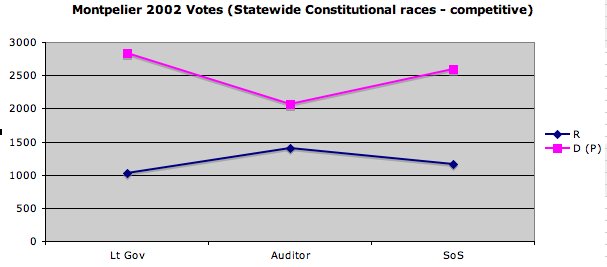
In this image, I’ve combined the votes for Pollina and Shumlin in the Lieutenant Governor column. On both the D/P and R ends, you see a very clear range. The Auditor’s race, I would argue, deviates from the range, as Elizabeth Ready was in the throes of her first scandal (the cell phone issue), and that took both her and her opponent out of their partisan baselines. I think the true baseline is a median line between Lite Gov and Secretary of State.
Now look what happens when we drop the Gubernatorial race in:
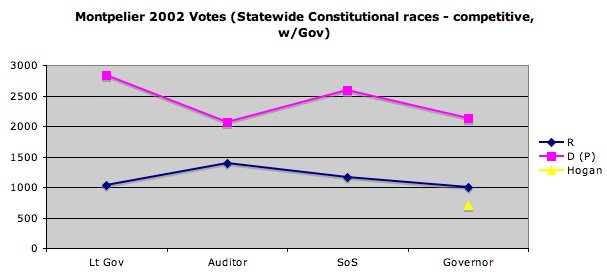
If the partisan baseline truly is the median between Lt Gov and SoS, it’s clear that Douglas stays within that zone (although barely), while Racine’s votes plunge right out – by an amount very close to the showing of Con Hogan.
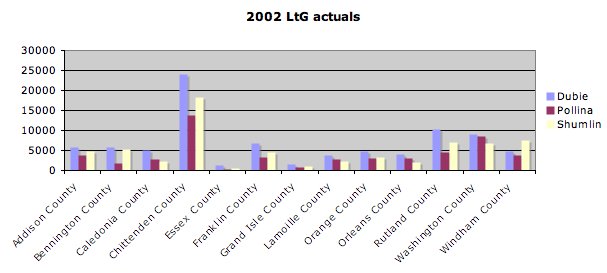
Now let’s look at the idea that Pollina can draw more from Republicans than Racine could. We looked at Pollina’s appeal to Republicans in this previous diary and saw that, while real, it’s manifestation in the ’02 Lieutenant Governor race was overstated. More importantly, though, is that it was clearly confined to the counties of Lamoille, Orleans and Caledonia. Here, again, are those numbers:
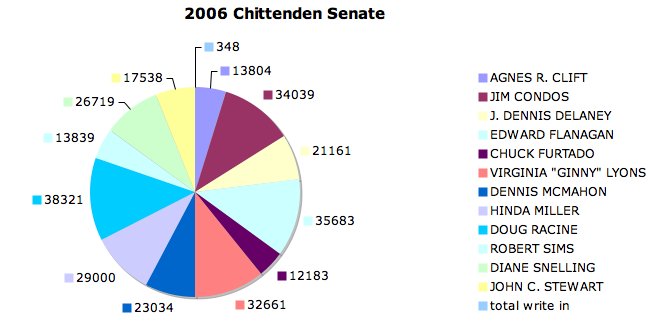
But Racine has his own regional appeal to Republicans – in the far more populace suburbs of Burlington, where votes would have to be mined in order to close the gap with Douglas statewide. In fact, as shown in this chart, Racine was the highest vote getter in Chittenden County this last election:
More to the point, however, is how well Racine recently did in the conservative enclaves outside Burlington – towns like South Burlington, Shelburne, Milton and Essex. The towns that have dragged on our statewide tickets in recent elections. As you’ll see from this chart, not only did he do well, he was also the highest vote getter in these four towns:
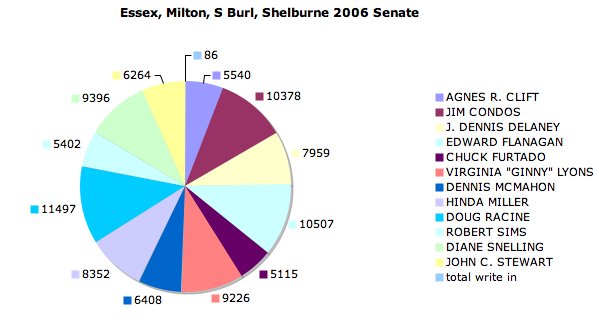
When Pollina ran for statewide office, he didn’t do so well there:
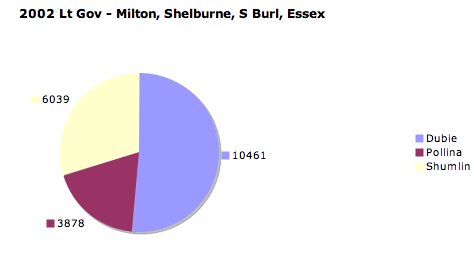
That’s means, in their most recent appearences in these swing towns, Racine collected a whopping 7619 more votes than Pollina did – even racking up 1580 more votes than Pollina and Shumlin combined. This is a bit of apples-to-oranges, as the Senate is a multiple choice ballot, but it shows Racine handily wins the popularity contest where Pollina didn’t by a significant margin.
Sure, you say, Pollina and Shumlin were running against Essex resident Brian Dubie.
Well, Racine has also run against Dubie – in the 2000 Lt. Governor’s race. Here are the numbers they posted in those conservative towns:
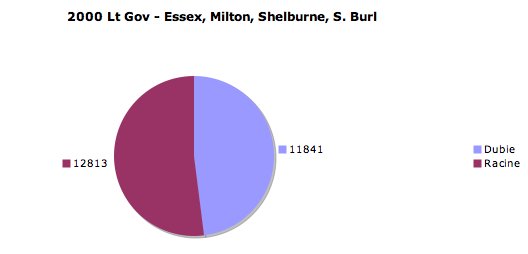
In fact, if you look at these numbers compared to his 2002 run against Douglas:
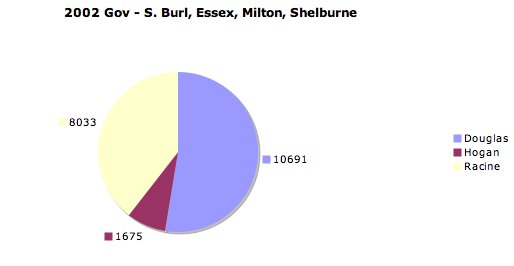
It seems likely that what everyone said was true: Racine underperformed, and hemorrhaged votes to spoiler Hogan, who hurt him badly.
But Douglas’s political star is clearly beginning to wane, with the recent WCAX poll showing, as I said at the time:
No two ways about it: the recent WCAX gubernatorial poll is huge. Here are Jim Douglas's re-elect numbers:
42 percent said they'd vote to re-elect Jim Douglas.
33 percent said they'd replace him.
25 percent said they were not sure.
Roper & company are trying to be blase about it, but this is a dramatic sea change. At this point in the last two cycles, Douglas's re-elect numbers were in the 60's. What's more ominous for the GOP is the significance of that number, which they no doubt recognize: 42%. It's roughly the mean, historical, hardcore GOP voting block that their statewides can depend on cycle after cycle. That's what he's down to, in terms of firm support.
…and in the meantime, with Racine posting higher numbers in these areas than ever in his career, his own cache with this group is clearly on the rise in a real, measurable way. The same cannot be mathematically demonstrated for Pollina, who has seemed to historically have very little interest in these areas. His limited strength in the northeast kingdom (and presumed increased numbers in Windham without Shumlin on the ballot) would be hard pressed to offset weakness in outer Chittenden, while simultaneously being expected to offset his questionable numbers in the rest of the state outside Washington County
Now any one of these arguments could be questioned. Racine was the popular incumbent when Dubie ran against him, while Dubie was the incumbent when Pollina and Shumlin ran against him. Time has passed since Racine was on a statewide ballot.
But when every argument mathematically suggests (if not truly concluding) on its face that Racine would be stronger, the individual “buts” start to lose meaning – and that’s because you’re looking at a trend. A systemic indication, and that becomes very hard to refute. And when you look again at the population spread, its clear that Chittenden County is where those votes are so badly needed, just as a matter of pure quantity. Pollina’s claim to a huge wave of support in Lamoille, Orleans and Caledonia counties is just too soft to offset the undeniable gains Racine would provide in suburban Chittenden, in my own opinion.
Racine’s appeal would cross from the liberal camp into that of the moderates, and there are many moderate business owners who would likely abandon Douglas for Racine, who they see as one of their own. Liberals would likely trust that Racine is on their side, even if he were to sometimes deviate from the liberal line. He, more than most, could hold together a left-center coalition, while Pollina would depend on a left-disaffected right coalition, Campbell and Galbraith would have a hard time establishing name recognition so late in the game, and Dunne would largely be an x-factor.
As I say, “electability” should hardly be the prime motivator in one’s choice of a horse to back. Hell, it maybe shouldn’t even make the top ten.
But don’t fool yourself about who has the mathematical mojo working for him among the current crop of pretenders, for whatever it’s worth.