UPDATE 4: This from the Freeps today:
Burlington’s Fletcher Allen Health Care confirmed one case Tuesday
Confirming that part of the disclosure doesn’t hurt the whistle-blower’s credibility. I think there may end up being more on all of this.
UPDATE 3: It took some work, but I did finally receive a definitive answer from FAHC’s communications person to the specific question “Did facilities people at FAHC tell medical personnel they had to reuse N95 masks?”
His answer via email was “no.” Specifically (and a bit ambiguously), the answer was “the short answer is no.”
Perhaps ironically followed by the phrase “which i thought i made very clear.”
UPDATE 2: Carrese has forwarded me a few things. Here is an image provided of the masks in question (N95). Here is an image of the masks that can be sterilized and re-used. And here is a word document describing FAHC’s official procedures on the use of the masks in this situation (and yes, sharp-eyed viewers may notice that this document is tagged as being created just this afternoon, but I am confident, either from cutting-and-pasting or whatever, that it is from September).
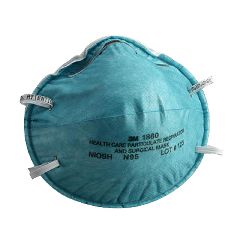

Of course, none of this contradicts what the whistle-blower reported. The story was not that standard written procedures deviated from appropriate protocols (such as those linked to in the original diary below), or that there were issues with training – the complaint (and the whole point of the diary) was that FAHC facilities administrators had directed them to deviate from standard procedure in a way that was unsafe, and that riled up the actual health care workers who know better. Someone from the facilities department was to be made available to speak with me, but that never actually materialized, unfortunately.
So questions still hang out there. Perhaps some folks on the ground at FAHC will materialize to set the record straight one way or the other. In any event, with this dustup, its probably safe to say that – if the report is accurate – any problem has probably been nipped in the bud.
UPDATE: Michael Carrese, Communications Strategist at Fletcher Allen Health Care strongly disputes this (obviously) whistle-blower driven post, making two points – a) the directive was to reuse and sterilize plastic masks, not the cloth N95 ones, because b) of a national shortage, rather than a specifically Fletcher Allen one. He would not affirmatively say for certain that no such directive was given on the N95 ones. He also took issue with the dual characterizations of sloppiness and the associated concern expressed in this diary – characterizations which, of course, would not be fair if the disclosure turns out to be inaccurate.
I am told that there will be affirmative documentation on the “real” story forthcoming. If the reports about N95 masks are not true, there is still a problem, albeit a rather less dramatic one – specifically communications; that health care workers are not receiving and/or understanding these directives (hence the blown whistle), which could clearly create problems as well.
The quote from the source was that workers were specifically told in regards to the N95 masks “you get one a day.” That makes for a pretty serious misunderstanding, if indeed it turns out to be one.
(Original diary text begins here) As of today, FAHC is currently treating at least one confirmed case of H1N1 flu in critical isolation. For anyone who just returned from Mars, the U.S. is suffering from an H1N1 pandemic or as FAHC refers to deadly pandemics: “the expected outbreak of flu this fall.”
With months to prepare, you would think that FAHC would be ready for its H1N1 patients. Let’s just say they are off to a really bad start.
One of the most basic precautions – as basic to H1N1 as, say, fill up the tank and put the key in the ignition is to driving a car – is to stock up on masks. Even the hospital’s website says people entering rooms of H1N1 patients need to wear masks, gowns and gloves. The mask required for an infectious disease such as H1N1 is the N95 mask.
All healthcare personnel who enter the rooms of patients in isolation with confirmed, suspected, or probable novel H1N1 influenza should wear a fit-tested disposable N95 respirator or better. Respiratory protection should be donned when entering a patient’s room.
True to this basic requirement, FAHC does require that health care workers and those dealing with the H1N1 virus must don an N95 mask. Problem is, FAHC is not so concerned about whether its health care workers are wearing a fresh and uncontaminated N95 face mask before entering or after leaving isolation areas with H1N1 flu patients are kept.
FAHC isn’t prepared, as of October 5, 2009, to supply its workers with sufficient N95 masks. Health care workers who are treating H1N1 flu in an isolation area of the hospital are specifically being told by the FAHC administration to “reuse” disposable masks, in direct contradiction of public safety protocols.
Is FAHC experiencing a Katrina moment? With months of predictions about the scope of the H1N1 pandemic, is FAHC prepared? Melinda Estes, CEO and her prescient infectious disease administrators seem to be blissfully unaware of what is hitting FAHC right now.
Let’s be clear; the problem is not a lack of resources, or of technical skill. Is this a case of the left hand not knowing what the right hand is up to? Does someone really need to tell the CEO and her crackerjack staff what happens when the airborne H1N1 virus starts floating around the family members, patients, staff, patients, health care providers and anyone else unlucky enough to be standing around when the Doctor McSwine says “hey, hold this mask for me until I get back from lunch, I’ll need it again for this afternoon’s rounds.”?
FAHC does have a few of these N95 masks.
FAHC administrators were apparently on the ball enough to realize they needed to order the masks, which physicians, nurses and other health care officials warned them were critical. Unfortunately, no one responsible for patient, staff and community safety bothered to read the directions and make provisions so that enough masks would be available to the health care workers treating H1N1.
Because of this shortage, health care workers are being told by the FAHC administration that they can’t throw their disposable masks away because “there may not be another one to replace it” and they need to “reuse” the contaminated masks that they have already worn (and, as you might expect, the workers on the pandemic front lines are not happy about this directive from the FAHC facilities department).
You read that correctly.
So to recap, the U.S. is in the midst of the most widely publicized pandemic in U.S. history. Luckily for Vermont, our State is late in the game receiving confirmed cases of the deadly H1N1 disease, and luckily for Vermonters, its hospitals had MONTHS to prepare. So why does FAHC not even have basic masks needed to treat H1N1 patients and to protect the public and its medical care staff? Anyone? Anyone? Mindy? Bueller? Anyone…?
Is this type of “Flu, what flu?” awareness an indication of what is in store for H1N1 patients at FAHC as Vermont moves from the outskirts of the pandemic into the mainstream? Let’s hope not.
I’m sure minds greater than mine can draw a connection between this screw-up and the need for overall health care reform. Me, I’m home for day three with, yup… H1N1. It’s not fun. I just took off my t-shirt as it is soaked through with sweat. The good news is that it appears to be about three days of hell–could be worse. I seem to be on the mend. However, I can see how this bug would be really serious for some. Stay well…
BD
When I visited Japan two years ago, I was told that the people wearing masks were the infected people, protecting everyone else from their germs.
Interesting cultural difference, eh? We put on the masks to protect ourselves.
to postpone that elective procedure indefinitely!